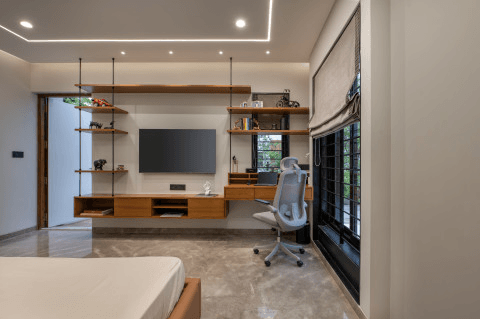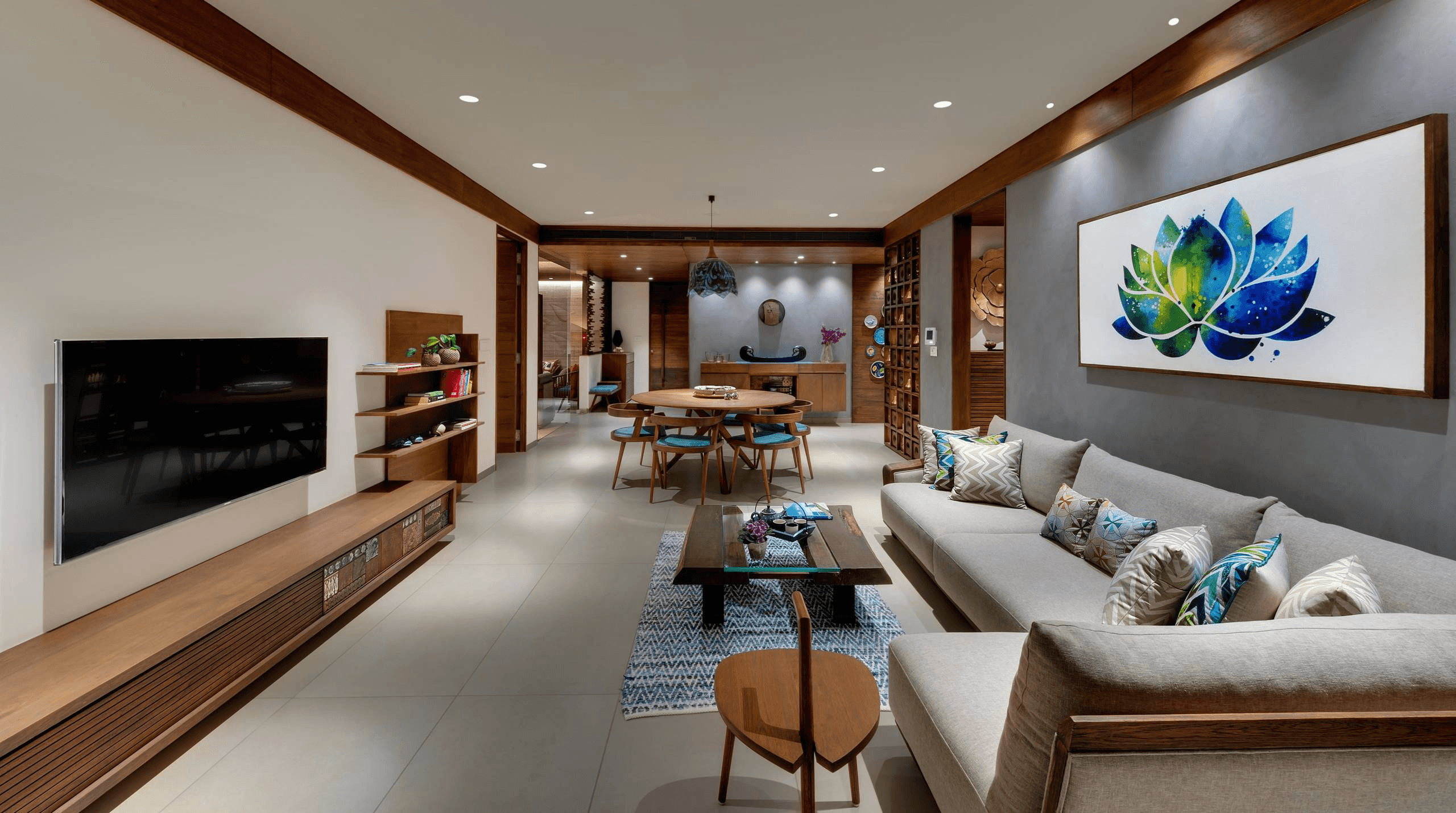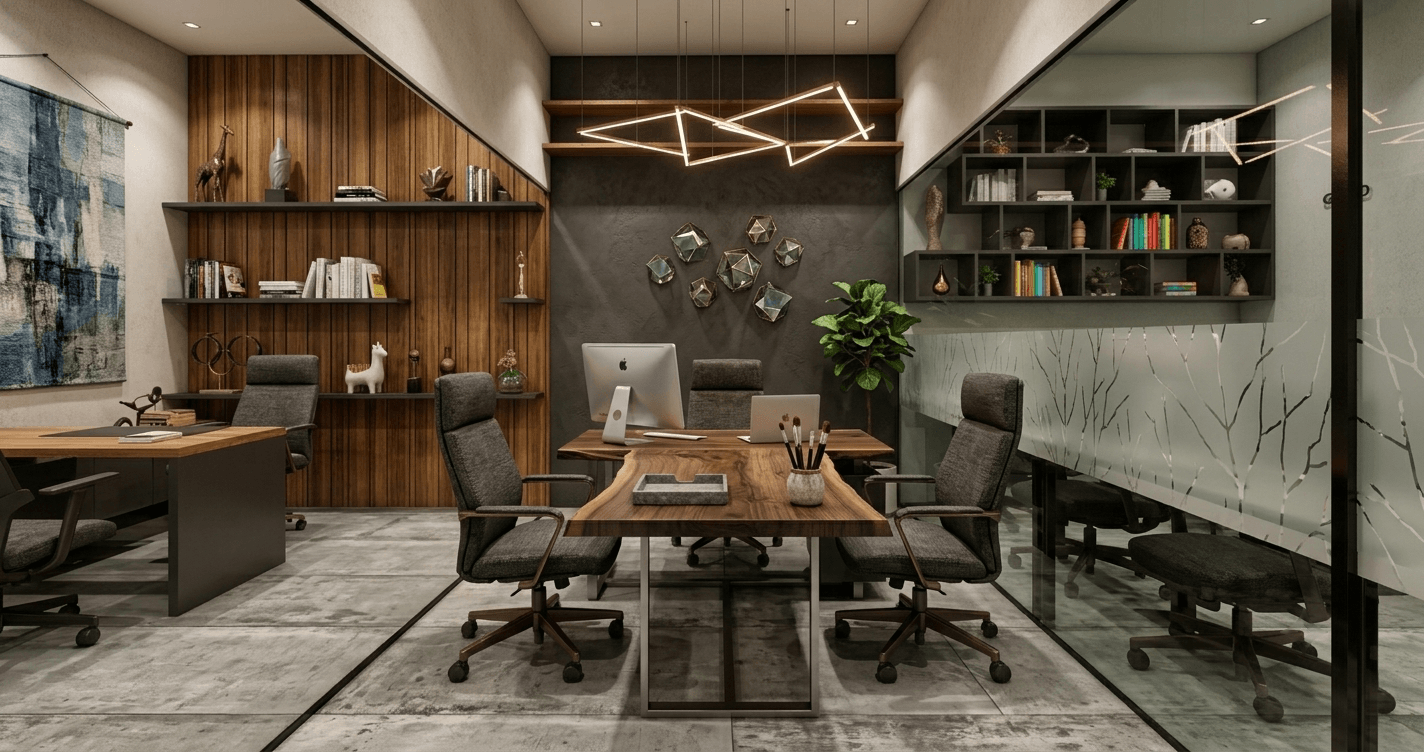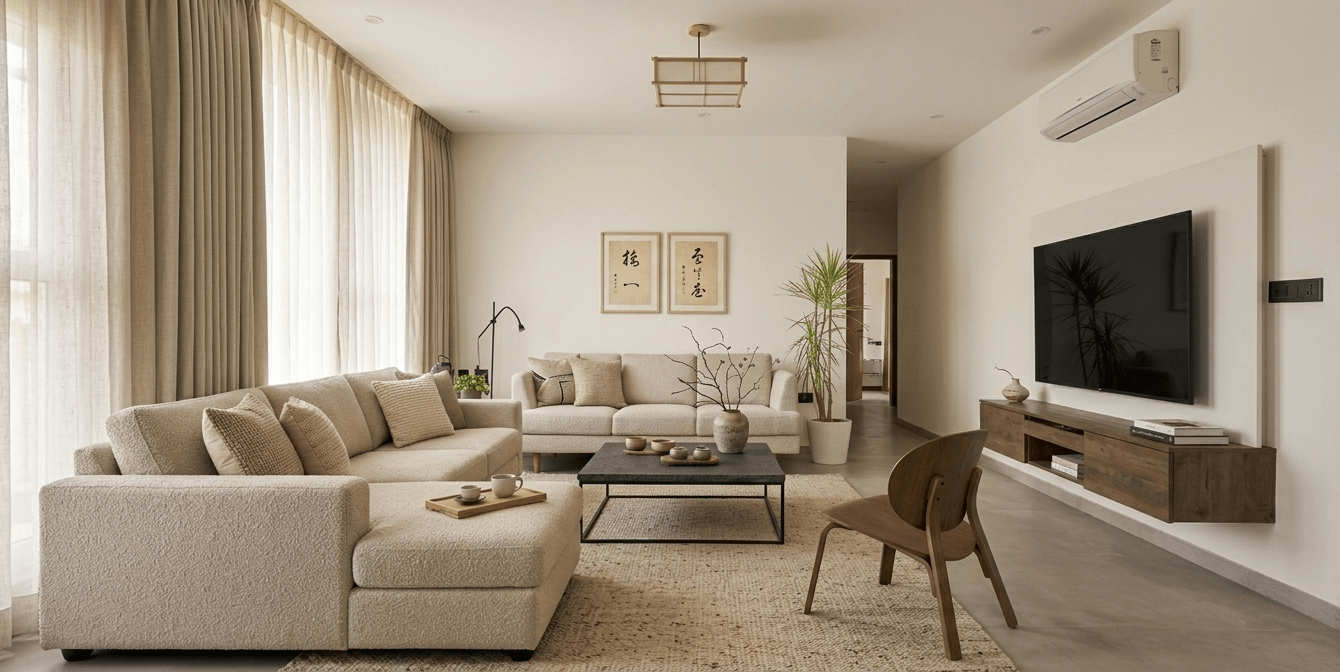
If you have ever looked at a professionally designed living room and wondered why everything appears to work together so naturally, the answer is often proportion, repetition, balance, and visual hierarchy.
The 3/4/5 rule in interior design is a simple styling framework that can help create a room that feels coordinated without looking overly matched or cluttered. One popular version of the method uses 3 patterns, 4 design influences or styles, and 5 colours or textures within a room.
The idea is not to follow the numbers rigidly. Instead, the 3-4-5 rule for decorating gives homeowners and interior designers a practical framework for deciding how much visual variety a space can handle.
For example:
- 3 = patterns
- 4 = design styles or influences
- 5 = colours and textures
When carefully combined, these layers can create an interior that feels balanced, interesting, personalised and visually cohesive.
At Ahmedabad Interior Designer, we use principles such as proportion, colour balance, material coordination and visual hierarchy when developing residential and commercial interiors. The goal is not simply to fill a room with beautiful products, but to make every element work together.
What Is the 3/4/5 Rule in Interior Design?
The 3/4/5 rule in interior design is a decorating and styling principle that encourages designers to control visual variety by working with three key layers:
| Number | Design Element | Typical Examples |
|---|---|---|
| 3 | Patterns | Rug, cushions, curtains, wallpaper |
| 4 | Styles or design influences | Modern, contemporary, classic, natural |
| 5 | Colours and textures | Wood, fabric, stone, metal, paint |
This framework prevents a room from becoming either too plain or visually chaotic.
For instance, instead of choosing eight unrelated patterns, six different furniture styles and numerous competing finishes, you can establish a controlled combination of patterns, styles, colours and textures.
The result is a space with visual rhythm and variety while maintaining a common design language.
Important note
The 3/4/5 rule is not a mandatory interior design law or building standard. It is a flexible styling guideline, and different designers interpret the numbers differently. Some contemporary interpretations use the numbers for furniture groupings, proportions or decorative arrangements rather than the 3-pattern/4-style/5-colour approach.
What Does the 3/4/5 Rule Mean?
The easiest way to understand the rule is to think of your interior in layers.
3 — Patterns
Start with approximately three main patterns.
Patterns can include:
- Geometric rugs
- Printed cushions
- Curtains
- Wallpaper
- Floral upholstery
- Textured wall panels
- Decorative artwork
You don’t necessarily need three bold patterns. One can be strong while the others are subtle.
4 — Styles or Design Influences
The second layer introduces different design influences.
For example, a living room could combine:
- Modern furniture
- Natural wooden elements
- Contemporary lighting
- A classic artwork or decorative piece
The key is to make the different influences feel intentional rather than random.
5 — Colours and Textures
The final layer introduces colour and material variation.
You might combine:
- Warm white
- Beige
- Natural wood
- Soft fabric
- Black metal
These materials and colours create depth without making the room feel disconnected.
Why Is the 3/4/5 Rule Important in Interior Design?
Good interior design is not simply about buying attractive furniture. It is about understanding how individual elements relate to one another.
The 3/4/5 approach can help with:
1. Creating visual balance
A room with too many competing elements can feel chaotic.
A room with too few elements can feel unfinished.
The 3/4/5 framework creates a middle ground.
2. Avoiding a monotonous interior
Using exactly the same colour, material and furniture finish everywhere can make a room feel flat.
Controlled variation introduces personality.
3. Creating visual rhythm
Repeating colours, patterns, materials or shapes helps the eye move naturally through the room.
4. Improving interior styling
The rule can help when selecting:
- Sofa fabrics
- Curtains
- Rugs
- Cushions
- Wall décor
- Lighting
- Furniture finishes
- Accessories
5. Preventing visual clutter
One of the biggest mistakes in home décor is continuously adding more items without considering how they relate to what is already there.
The 3/4/5 approach encourages intentional selection rather than random decoration.
How to Use the 3/4/5 Rule in Your Home?
You don’t have to redesign your entire home to use this principle.
Start with one room.
Step 1: Select Three Patterns
Choose up to three complementary patterns.
For example, in a living room:
- Geometric rug
- Subtle cushion print
- Textured curtain
If one pattern is very bold, keep the other two understated.
Interior design tip: Patterns do not have to be visually identical. They should simply share a colour, scale, shape or overall aesthetic.
Step 2: Introduce Four Design Influences
Now look at the furniture and architectural elements.
For a modern Indian living room, you could combine:
- Contemporary sofa
- Natural wood TV unit
- Minimal pendant light
- Traditional artwork
This creates an eclectic yet coordinated interior.
The trick is controlling the relationship between the elements.
Step 3: Build a Five-Element Colour and Texture Palette
Instead of choosing colours independently, create a complete palette.
For example:
Warm white + beige + walnut wood + soft upholstery + black metal
Each material contributes something different.
Wood adds warmth.
Fabric adds softness.
Metal adds contrast.
Neutral walls provide a calm background.
3/4/5 Rule for Living Room Design
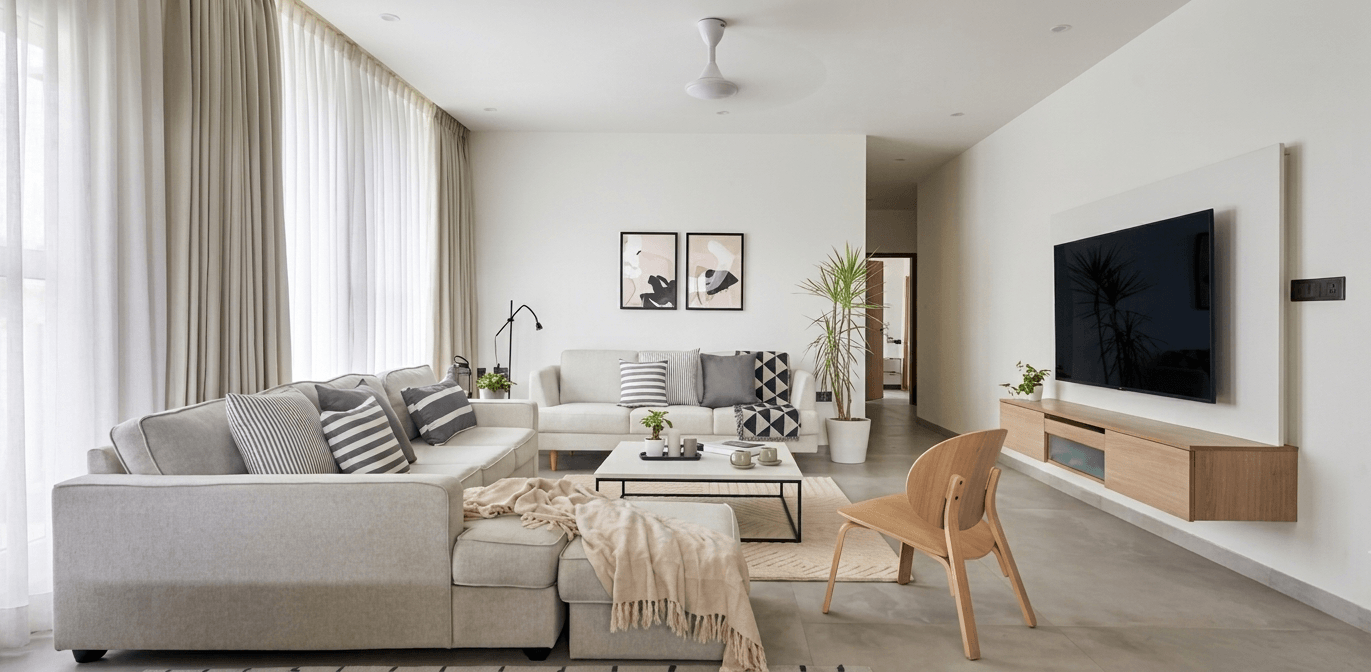
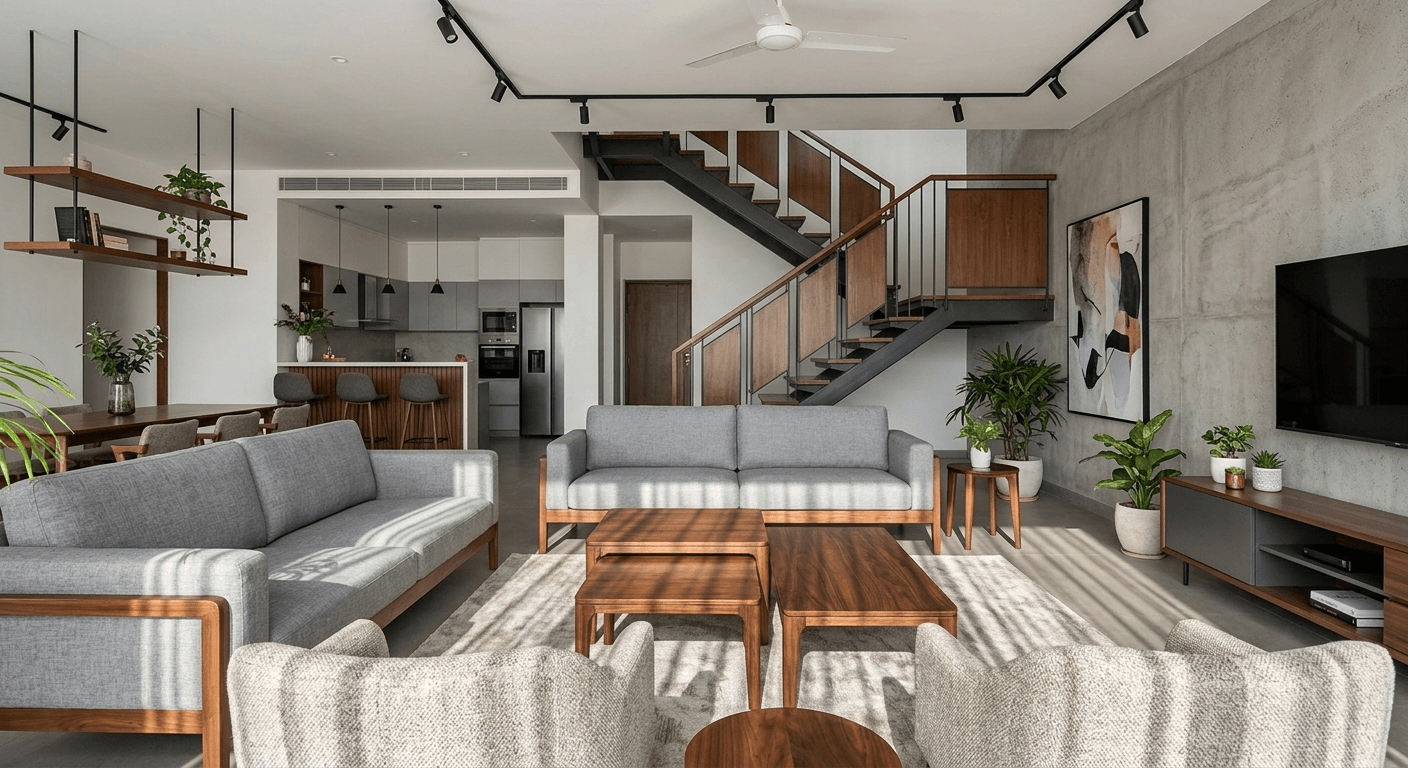
The living room is one of the best places to apply the 3/4/5 interior design rule because it usually contains multiple furniture pieces, textiles, lighting elements and decorative accessories.
A practical example could be:
Three patterns
- Geometric rug
- Printed cushions
- Subtle curtain texture
Four design influences
- Contemporary sofa
- Wooden furniture
- Modern lighting
- Traditional artwork
Five colours/textures
- Off-white
- Beige
- Walnut
- Fabric
- Matte black
This gives the room enough variety to feel interesting while keeping the overall interior cohesive.
For an Indian living room interior, you can also introduce locally inspired artwork, wooden finishes, handcrafted accessories or traditional patterns without making the room feel outdated.
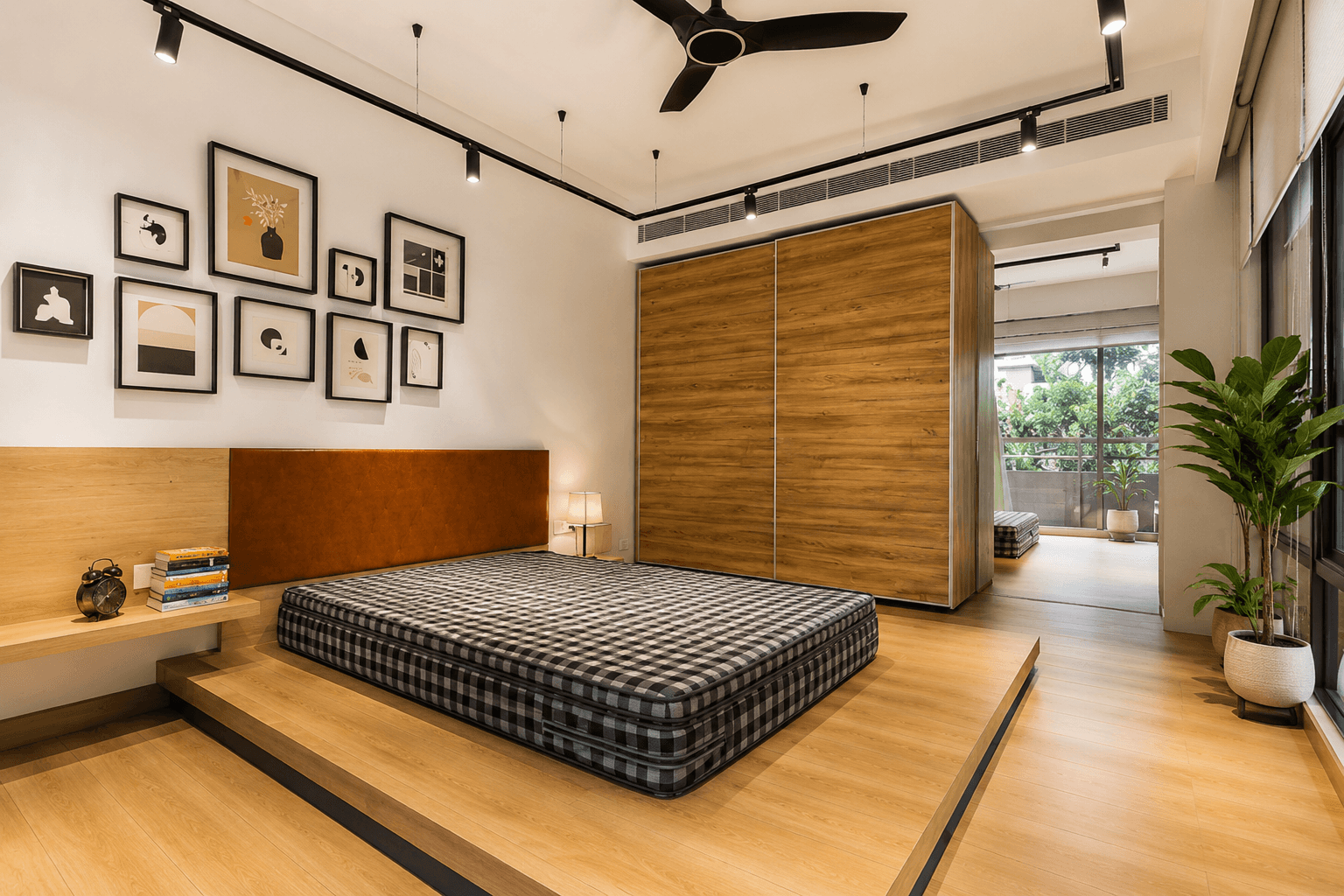
3/4/5 Rule for Bedroom Interior Design
Bedrooms require a more restrained approach because the objective is usually comfort, relaxation and visual calm.
For example:
3 patterns
- Bed linen
- Cushions
- Curtains
4 design influences
- Contemporary bed
- Minimal bedside tables
- Soft lighting
- Natural wood accents
5 colours and textures
- Cream
- Beige
- Wood
- Upholstery
- Soft metallic accent
Avoid making every element a focal point.
Your bed should generally remain the primary visual anchor, while lighting, wall décor and textiles support it.
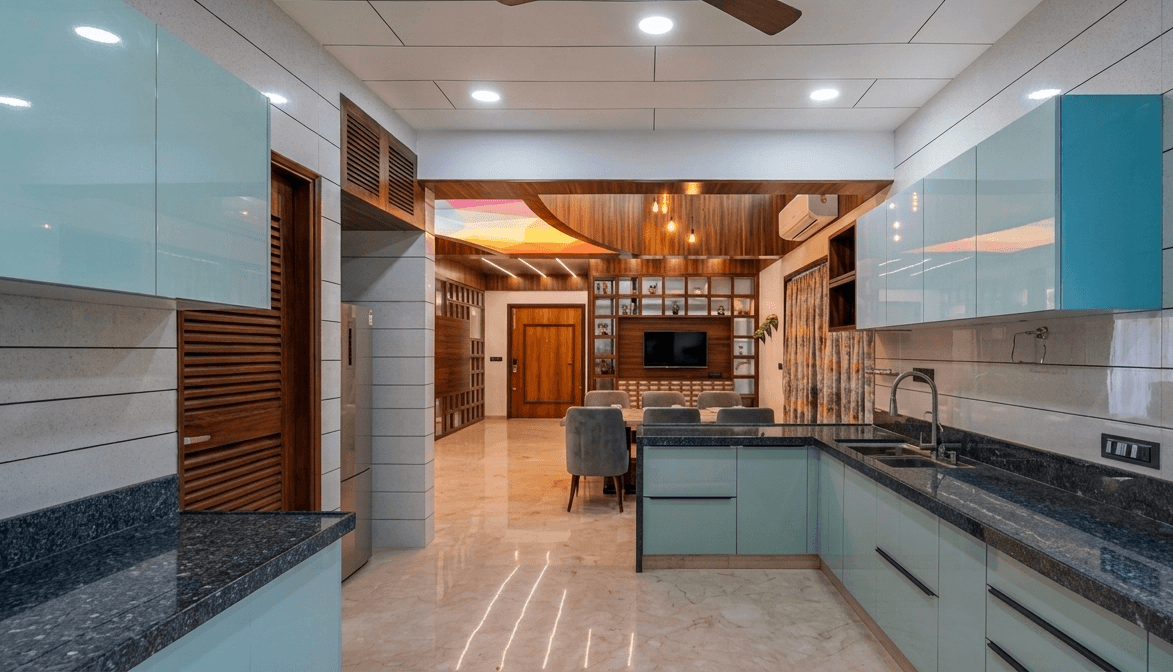
3/4/5 Rule for Modular Kitchen Design
The same thinking can be applied to a modular kitchen.
For example:
Three visual patterns
- Backsplash pattern
- Cabinet texture
- Flooring pattern
Four design influences
- Modern cabinetry
- Natural wood
- Minimal hardware
- Contemporary lighting
Five finishes
- Matte laminate
- Wood veneer
- Quartz
- Glass
- Metal
The objective is to prevent the kitchen from having too many competing finishes.
For smaller kitchens, keeping the palette simpler can make the room feel larger and more organised.
3/4/5 Rule for Home Décor
The rule can also be useful when styling smaller surfaces such as:
- TV units
- Console tables
- Bookshelves
- Open shelving
- Coffee tables
- Bedroom side tables
- Dining consoles
For example, a console could combine:
- One framed artwork
- One decorative object
- One plant
Then introduce variation through height, material and texture.
The goal is not to fill every empty space.
Negative space is also an important part of interior design.
How the 3/4/5 Rule Helps With Colour Selection?
Colour is one of the most important components of interior design.
Instead of choosing individual colours randomly, create a connected palette.
For example:
Primary: Warm ivory
Secondary: Beige
Material: Natural oak
Accent: Olive green
Contrast: Matte black
This creates a sophisticated neutral interior while still providing visual contrast.
However, the 3/4/5 rule should not be confused with the 60-30-10 colour rule, which is a different proportion-based colour guideline.
The 60-30-10 method generally allocates a dominant colour, secondary colour and accent colour in approximate percentages, whereas the 3/4/5 decorating method is often used to control patterns, styles, colours and textures.
What Is the Difference Between the 3/4/5 Rule and the 3-5-7 Rule?
These rules are often confused because their names sound similar.
3/4/5 Rule
The 3/4/5 rule is used as a broader decorating and composition framework, with popular interpretations involving patterns, design influences, colours and textures.
3-5-7 Rule
The 3-5-7 rule is more commonly associated with grouping decorative objects and creating visual rhythm, where objects are arranged in groups or layers to create interest.
Neither should be treated as an absolute law.
Professional interior designers select the appropriate principle according to the room, furniture, architecture and client’s requirements.
Is the 3/4/5 Rule the Same as the 3-4-5 Geometry Rule?
No.
This distinction is important.
The 3-4-5 geometry rule comes from the mathematical relationship of a right triangle. A triangle with sides of 3, 4 and 5 units forms a right angle.
The 3/4/5 decorating rule is a styling concept used to organize visual elements within an interior.
They may share the same numbers, but they serve different purposes.
For interior design, we are talking about the decorating and visual composition principle, not a mathematical method for constructing right angles.
Can You Use the 3/4/5 Rule in a Small Home?
Yes.
In fact, proportional thinking can be particularly useful in compact apartments.
For a smaller home:
- Avoid too many patterns.
- Keep the main colour palette cohesive.
- Use similar materials across connected spaces.
- Introduce contrast through smaller accessories.
- Avoid oversized furniture.
- Maintain clear circulation paths.
- Use multifunctional storage.
- Allow sufficient negative space.
For an apartment in Ahmedabad, for example, a compact living room can combine a neutral sofa, wood-finish TV unit, textured rug, soft curtains and carefully selected artwork without needing dozens of decorative pieces.
Common Mistakes When Using the 3/4/5 Rule
The rule works best when treated as a guide rather than a formula.
Mistake 1: Taking the numbers literally
You don’t need exactly three patterns, four styles and five textures in every room.
Mistake 2: Adding too many colours
A five-colour palette does not mean five bright colours.
Several colours can be subtle variations of the same family.
Mistake 3: Mixing unrelated styles
Eclectic interiors can be beautiful, but random combinations can make a room feel disjointed.
Mistake 4: Making every element a focal point
A successful room needs hierarchy.
Choose a few major focal points and allow supporting elements to remain quieter.
Mistake 5: Ignoring room size
A styling approach that works in a large villa may need to be simplified for a compact apartment.
Mistake 6: Forgetting functionality
A beautiful interior still needs to work for everyday life.
Furniture placement, storage, circulation, lighting and maintenance should come before decorative styling.
3/4/5 Rule vs Other Interior Design Rules
Interior designers use many different principles to create balanced spaces.
| Interior Design Rule | Main Purpose |
|---|---|
| 3/4/5 Rule | Visual variety and coordinated styling |
| Rule of Three | Creating visual interest through grouping |
| 60-30-10 Rule | Colour distribution |
| 3-5-7 Rule | Decorative grouping and visual rhythm |
| Golden Ratio | Proportion and scale |
| Symmetry | Balance and order |
| Contrast | Creating visual interest |
| Repetition | Connecting different areas of a room |
The best interior design doesn’t depend on one rule.
Professional designers often combine several principles according to the architecture and requirements of the space.
Do Interior Designers Really Follow the 3/4/5 Rule?
Yes, designers frequently use proportion, repetition, layering, scale and visual hierarchy, but they don’t necessarily calculate every decision using a fixed formula.
The 3/4/5 rule is best understood as a starting framework.
A professional designer will also consider:
- Room dimensions
- Ceiling height
- Natural light
- Furniture scale
- Existing architecture
- Lifestyle
- Storage requirements
- Material durability
- Budget
- Colour psychology
- Vastu requirements where applicable
- Maintenance
- Overall design style
This is why two rooms following the same basic design principle can look completely different.
How Ahmedabad Interior Designer Uses Design Principles in Real Homes?
At Ahmedabad Interior Designer, we approach interiors as complete spaces rather than collections of individual products.
Our design process considers the relationship between:
Space + Function + Furniture + Colour + Lighting + Materials + Storage + Execution
For residential projects, this can include:
- Living room interior design
- Bedroom interior design
- Modular kitchen design
- Wardrobe design
- TV unit design
- False ceiling design
- Lighting design
- Vastu-compliant space planning
- 3D interior visualization
- Custom carpentry
- Electrical work
- Painting and finishing
- Complete turnkey interior execution
Our in-house approach helps maintain consistency from initial design and 3D visualization through execution and final handover.
For homeowners planning a new apartment, villa or bungalow interior in Ahmedabad or Gujarat, these principles can help create a home that feels intentional, functional and visually balanced rather than simply decorated.
Frequently Asked Questions About the 3/4/5 Rule in Interior Design
What is the 3/4/5 rule in interior design?
The 3/4/5 rule is a flexible interior decorating guideline used to create visual balance and variety. A popular interpretation uses three patterns, four design influences or styles, and five colours or textures within a room.
What does 3/4/5 mean in interior design?
In one popular decorating interpretation, 3 represents patterns, 4 represents design styles or influences, and 5 represents colours and textures. The exact application can vary between designers.
Is the 3/4/5 rule a strict rule?
No. It is a styling guideline, not a mandatory interior design standard. Designers can adapt or break it depending on the room’s size, architecture, function and aesthetic.
How do I use the 3/4/5 rule in a living room?
Start with up to three complementary patterns, introduce several compatible design influences, and develop a coordinated palette of colours and textures. Keep one or two elements dominant and use the others as supporting details.
Can the 3/4/5 rule be used in a bedroom?
Yes. It can help coordinate bedding, curtains, rugs, furniture finishes, lighting and accessories while keeping the bedroom visually calm.
Is the 3/4/5 rule the same as the 60-30-10 rule?
No. They are different decorating concepts. The 60-30-10 rule focuses on approximate colour proportions, while popular versions of the 3/4/5 method focus on patterns, styles, colours and textures.
Is the 3/4/5 rule the same as the 3-5-7 rule?
No. They are separate design concepts. The 3-5-7 approach is generally associated with grouping and visual rhythm, while 3/4/5 has several decorating interpretations involving proportion, styling and visual variety.
Can I use the 3/4/5 rule in a small apartment?
Yes. In a compact home, use the principle more selectively. Limit competing patterns, coordinate your colour palette and prioritise functional furniture and clear circulation.
Does the 3/4/5 rule work for modern Indian homes?
Yes. The framework can be adapted to contemporary Indian apartments, villas and bungalows by combining modern furniture with materials such as natural wood, stone, textured fabrics, metal, Indian artwork and handcrafted accents.
Final Thoughts
The 3/4/5 rule in interior design is ultimately about creating a controlled relationship between patterns, styles, colours, textures and visual elements.
You don’t have to follow the numbers rigidly.
Instead, use the principle to ask:
Is there enough variety to make the room interesting?
Is there enough repetition to make the design cohesive?
Are the colours, textures and furniture working together?
Does the room have a clear visual hierarchy?
When these elements are balanced correctly, even a relatively simple room can look polished and professionally designed.
For homeowners planning a home interior design, apartment interior, villa interior or office interior in Ahmedabad and Gujarat, applying design principles like the 3/4/5 rule alongside proper space planning, material selection, lighting and execution can make a significant difference to the final result.
The best interior is not the one with the most elements. It is the one where every element has a reason to be there.