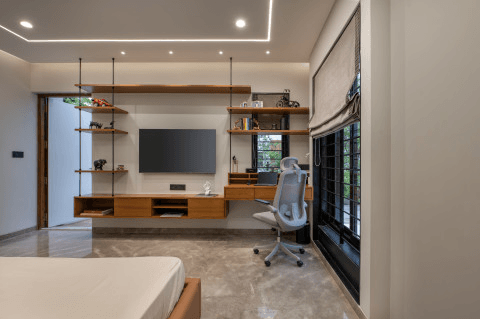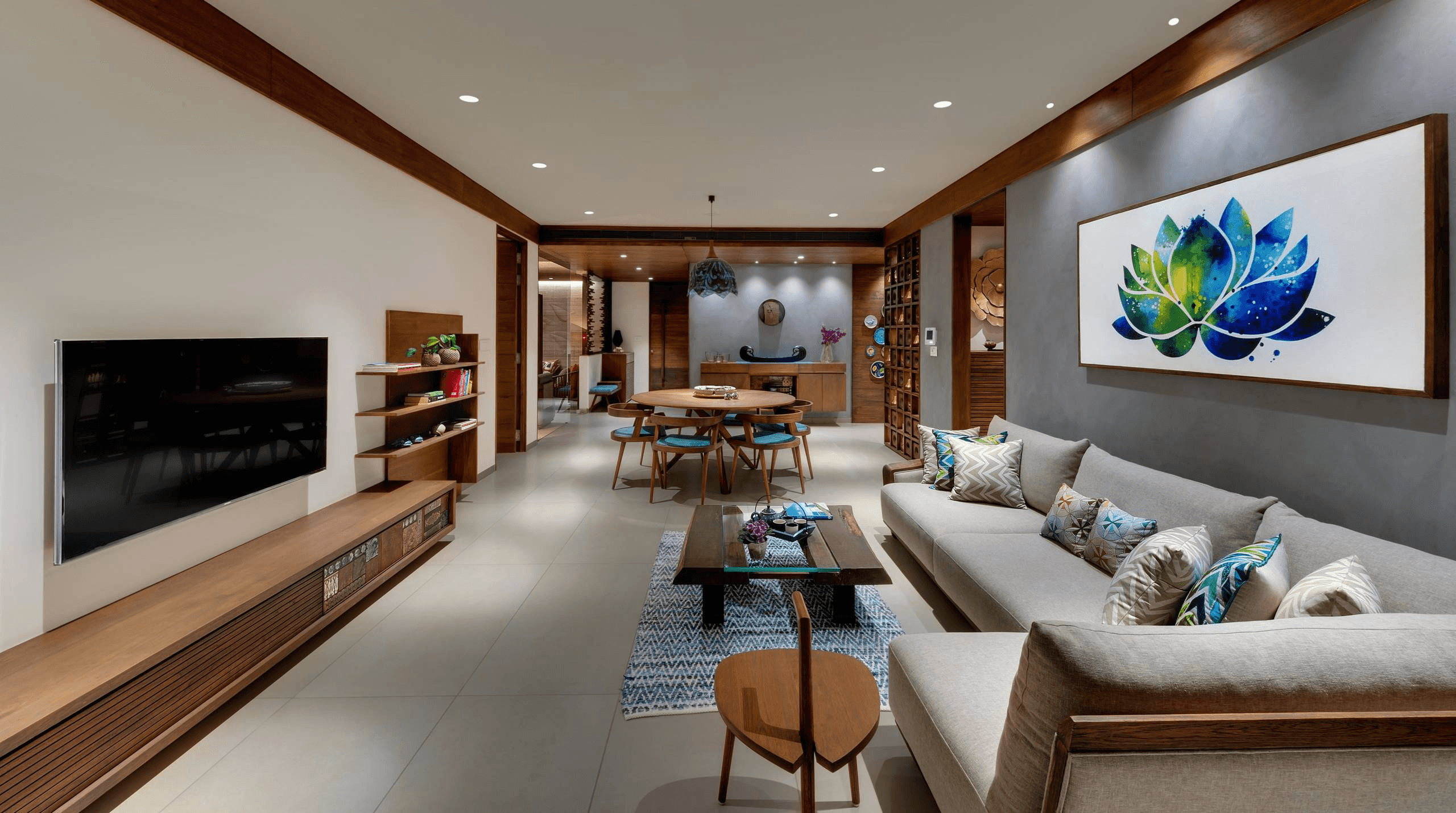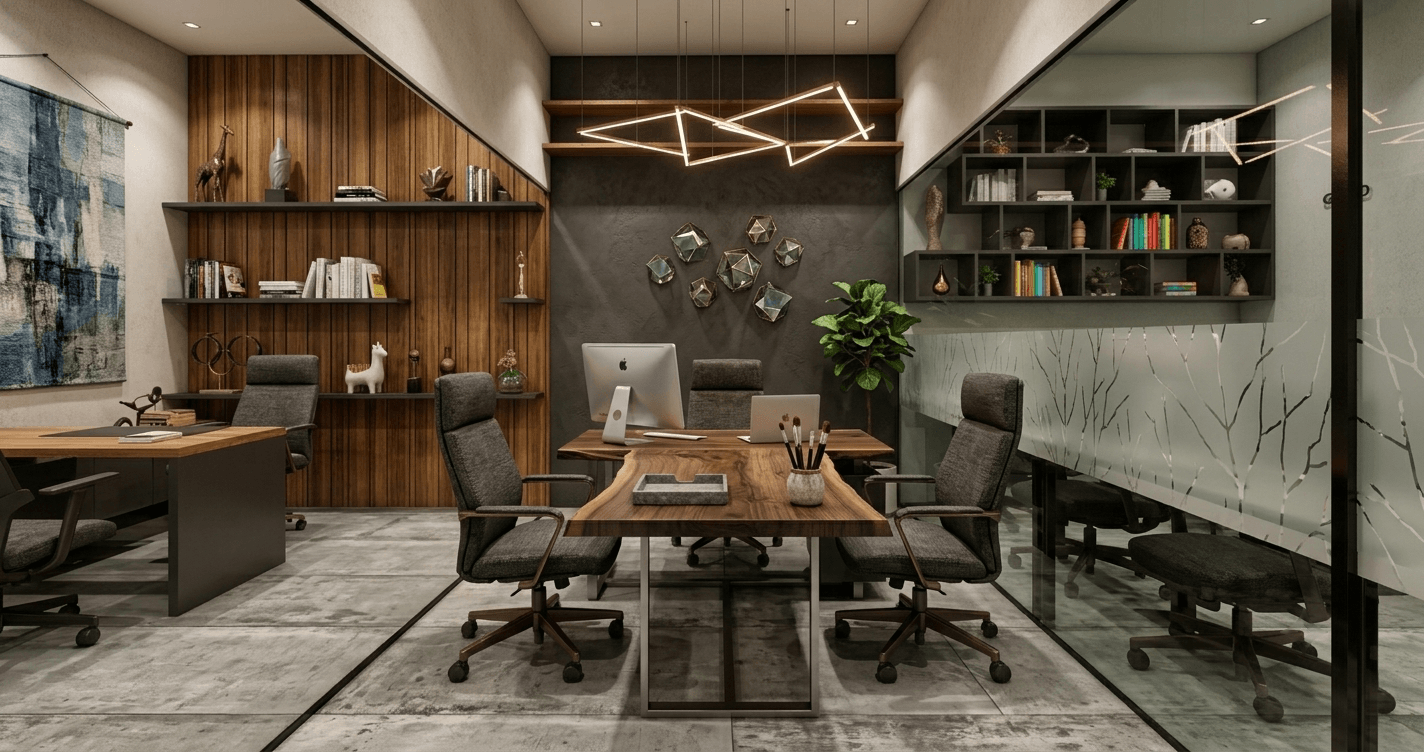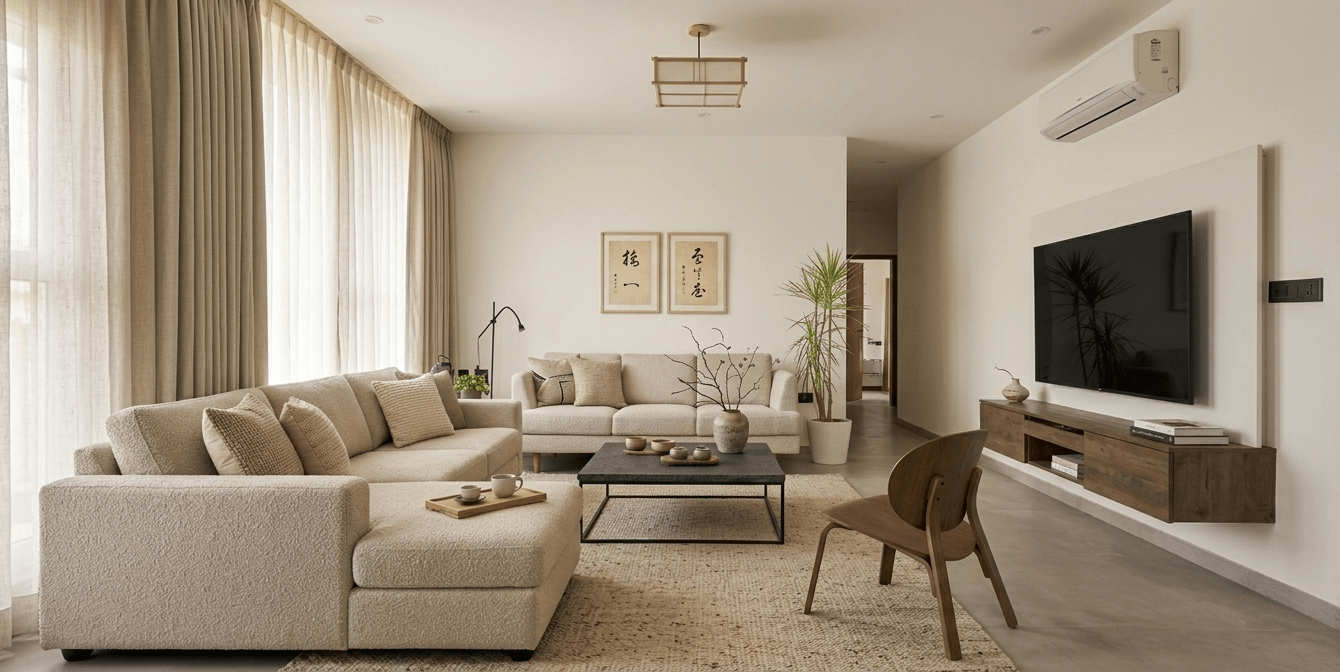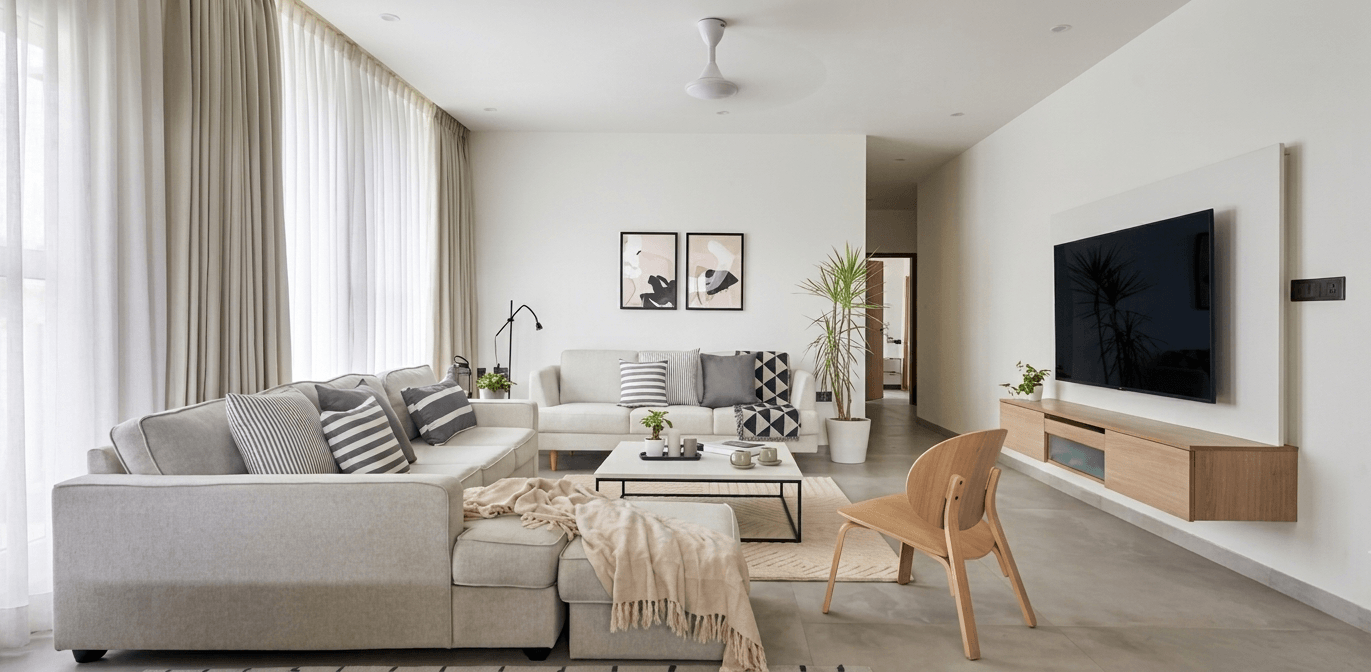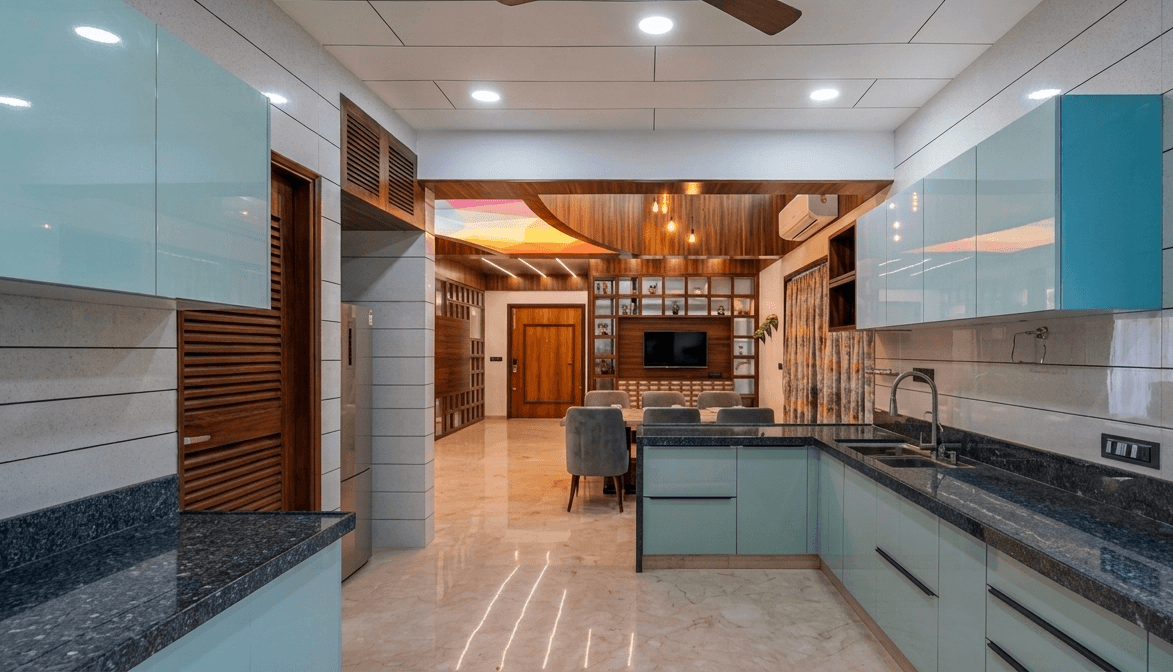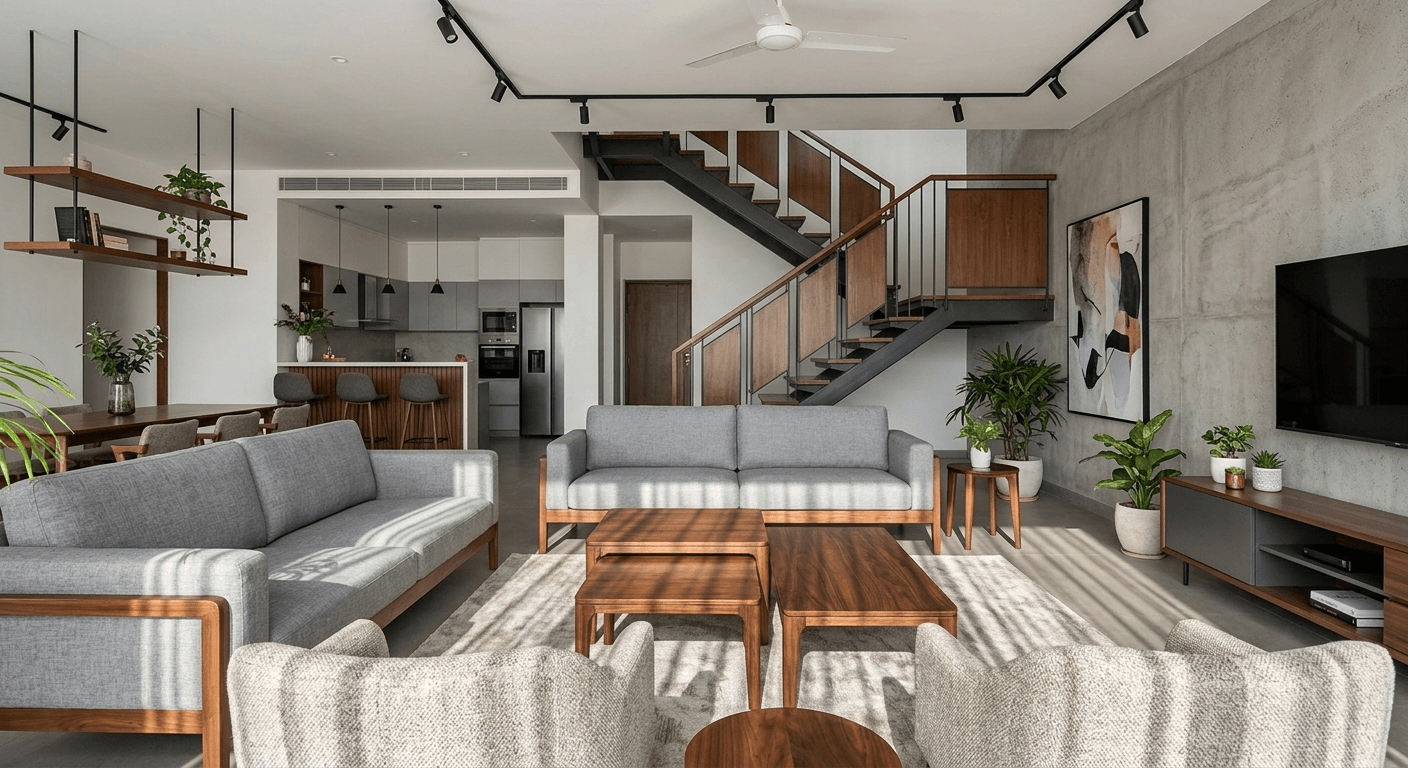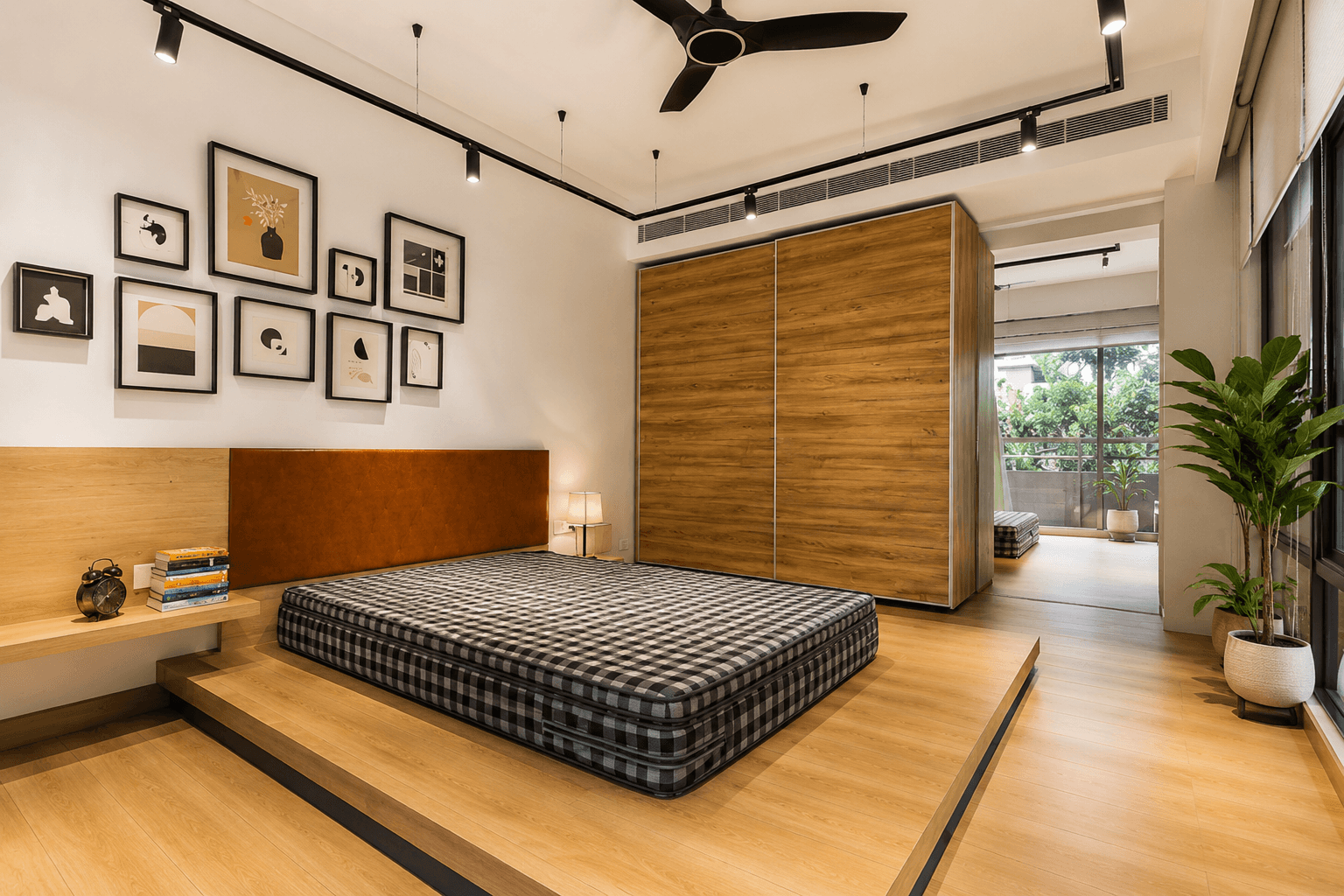
Have you ever looked at a beautifully designed living room, TV unit, bookshelf, coffee table or console and wondered why everything looks so perfectly balanced?
The answer is often not expensive furniture or luxury décor. It is how the elements are grouped and arranged.
The 3-5-7 rule in interior design is a simple styling principle that recommends arranging decorative elements in odd-numbered groups of three, five or seven. The idea is that odd-numbered arrangements tend to create more visual movement, natural asymmetry and interest than perfectly matched even-numbered groupings.
For example, instead of placing two identical décor pieces on a console table, an interior designer might create a group of three: a tall vase, a stack of books and a small decorative object.
The result feels balanced without looking overly symmetrical or staged.
At Ahmedabad Interior Designer, we use principles such as proportion, scale, balance, colour, texture, lighting and visual hierarchy to create interiors that are not only beautiful but also practical and comfortable.
What Does the 3-5-7 Rule Mean in Interior Design?
The 3-5-7 decorating rule means grouping accessories and decorative elements in odd numbers, particularly:
- 3 items for simple, minimal arrangements
- 5 items for medium-sized displays with more layering
- 7 items for larger shelves, consoles, feature walls or gallery-style arrangements
The principle is closely related to the broader rule of three, which has long been used in visual composition. Odd-numbered groups can encourage the eye to move through an arrangement instead of immediately reading it as two matching pairs.
However, the 3-5-7 rule should be treated as a design guideline rather than a rigid formula.
You do not need exactly seven accessories in every room. In fact, adding unnecessary objects simply to reach seven can make a space feel cluttered.
Simple example
Instead of:
2 objects:
Vase + candle
Try:
3 objects:
Tall vase + books + candle
Or:
5 objects:
Plant + books + sculpture + candle + decorative bowl
The goal is not simply to count objects. The goal is to create visual hierarchy, rhythm and balance.
Why Does the 3-5-7 Rule Work?
The reason odd-numbered arrangements are popular in interior styling is that they can create a more dynamic visual composition.
When objects are arranged in pairs, the eye can quickly identify the symmetry:
Object A + Object A
That can create a formal and predictable appearance.
With three or five objects, however, there is usually a stronger opportunity to establish a focal point, different heights and visual movement.
This is particularly useful when styling:
- Living rooms
- Bedrooms
- TV units
- Bookshelves
- Console tables
- Coffee tables
- Entryways
- Home offices
- Gallery walls
- Open kitchen shelves
- Dining areas
- Reception areas
- Office interiors
The principle is based on visual composition rather than a mathematical requirement. Professional designers still consider the room’s scale, proportions, function and overall design style before deciding how many elements to use.
3-5-7 Rule: What Do 3, 5 and 7 Represent?
1. Three — Simple and Minimal
Three is usually the easiest number to work with.
A group of three can create a clear visual hierarchy:
- Tall
- Medium
- Low
For example, on a living room console:
- Tall decorative vase
- Medium-sized artwork or sculpture
- Low decorative bowl
This creates variation without making the surface look crowded.
Best for:
- Coffee tables
- Bedside tables
- Small shelves
- Console tables
- TV units
- Small entryway tables
For minimalist interior design, three carefully selected objects are often better than many small accessories.
2. Five — Layered and Balanced
Five objects give you more flexibility.
For example, a bookshelf could contain:
- A plant
- Two stacked books
- A decorative vase
- A sculpture
- A framed photograph
The objects do not have to be identical. In fact, mixing height, texture, shape and material can make the arrangement more interesting.
Five works particularly well on larger surfaces because it provides enough elements to create layers without necessarily becoming visually overwhelming.
3. Seven — Rich and Collected
Seven is useful when you have a larger surface or feature area.
For example, a large console table could feature:
- Table lamp
- Decorative vase
- Books
- Sculpture
- Indoor plant
- Bowl
- Small artwork
However, seven objects need sufficient space.
Trying to place seven accessories on a small coffee table can make the table look crowded rather than sophisticated.
The size of the space should always determine the scale and number of accessories.
How to Use the 3-5-7 Rule in Your Home
The 3-5-7 rule can be incorporated into almost every room, but it works particularly well for interior styling and décor arrangements.
3-5-7 Rule for Living Room Interior Design
Your living room is one of the easiest places to apply this principle.
Consider a coffee table with three elements:
- Decorative tray
- Small indoor plant
- Candle or sculpture
For a larger console, you could use five decorative elements with different heights.
For a feature bookshelf, seven carefully distributed objects can create a more collected appearance.
The important thing is to avoid making every surface symmetrical.
3-5-7 Rule for TV Unit Design
Modern TV units often include open shelves where décor can easily become cluttered.
Instead of filling every shelf, create small groups.
For example:
Shelf 1: 3 objects
Shelf 2: 5 objects
Shelf 3: 3 objects
You can combine:
- Books
- Small plants
- Vases
- Sculptures
- Family photographs
- Decorative boxes
Leave some negative space between groups so the TV unit can breathe.
A well-designed TV wall should balance décor with the television, storage requirements and architectural elements.
3-5-7 Rule for Bookshelves
Bookshelves are perfect for applying the 3-5-7 principle.
Instead of lining up every object at the same height, vary the composition.
For example:
Group of 3
- Tall vase
- Medium book stack
- Small sculpture
Group of 5
- Plant
- Books
- Frame
- Bowl
- Decorative object
Group of 7
Use a larger bookshelf or display unit where several smaller groups can be visually connected.
The trick is to create different heights and shapes while maintaining a common colour or material connection.
3-5-7 Rule for Coffee Table Styling
A coffee table can quickly look messy when too many decorative items are added.
The 3-5-7 rule offers a simple starting point.
Try three items:
Books + plant + decorative object
Or:
Tray + candle + vase
If your table is large enough, you can create a five-item arrangement by adding:
- A bowl
- A sculpture
- A second book stack
- Decorative coasters
- A small floral arrangement
Always consider the practical purpose of the coffee table. People should still have enough space to place a cup, book or other everyday items.
3-5-7 Rule for Bedroom Interior Design
The bedroom generally benefits from a quieter approach.
You could use three decorative elements on a dresser:
- Lamp
- Artwork
- Decorative vase
On an open shelf, five items can create a layered look without overwhelming the room.
For bedside tables, however, symmetry may be better.
For example, two matching bedside lamps on either side of the bed can create a sense of calm and order.
This is an important point:
Good interior design is not about following the 3-5-7 rule everywhere. It is about knowing when to use it and when to use symmetry instead.
Formal bedrooms and luxury interiors often benefit from symmetrical elements around a central bed.
3-5-7 Rule for Wall Décor and Gallery Walls
The principle can also be used when creating a gallery wall.
Instead of randomly hanging frames, you could experiment with:
- 3 artworks
- 5 photographs
- 7 smaller frames
But the number alone does not guarantee a good result.
You also need to consider:
- Frame size
- Artwork style
- Spacing
- Wall dimensions
- Furniture below the wall
- Colour palette
- Focal point
- Overall room proportions
A gallery wall with five carefully coordinated frames can look far better than seven unrelated frames.
3-5-7 Rule for Interior Design Colour and Accessories
There is another interpretation of the 3-5-7 concept in interior design that discusses layering colours and decorative accents. However, the more commonly referenced 3-5-7 decorating rule focuses on odd-numbered groupings of objects.
For a cohesive interior, you can still use the principle to distribute an accent colour.
For example, if your living room has:
- Neutral walls
- Beige sofa
- Wooden furniture
You could repeat one accent colour through three, five or seven small details:
- Cushions
- Artwork
- Vase
- Rug detail
- Decorative object
This repetition helps connect different areas of the room.
3-5-7 Rule for Indian Home Interiors
The principle works particularly well in Indian homes because modern Indian interiors often combine functionality, décor, storage and personal elements.
For an Ahmedabad home, for example, you might use:
Living room
3 decorative objects on the coffee table.
TV unit
5 carefully selected accessories across open shelves.
Console
3 or 5 objects depending on its size.
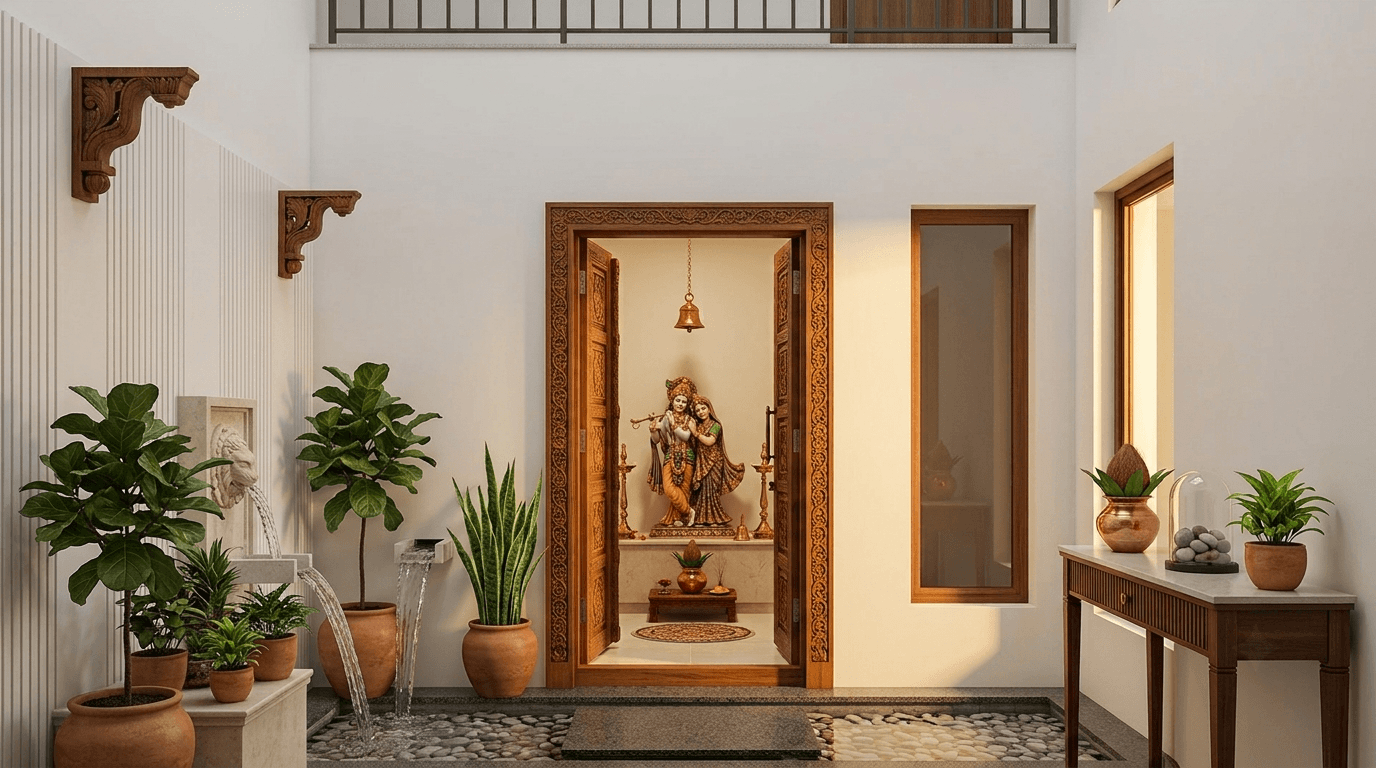
Pooja area
Use the principle subtly while maintaining the spiritual and functional requirements of the space.
Bedroom
Use minimal accessories and prioritize comfort.
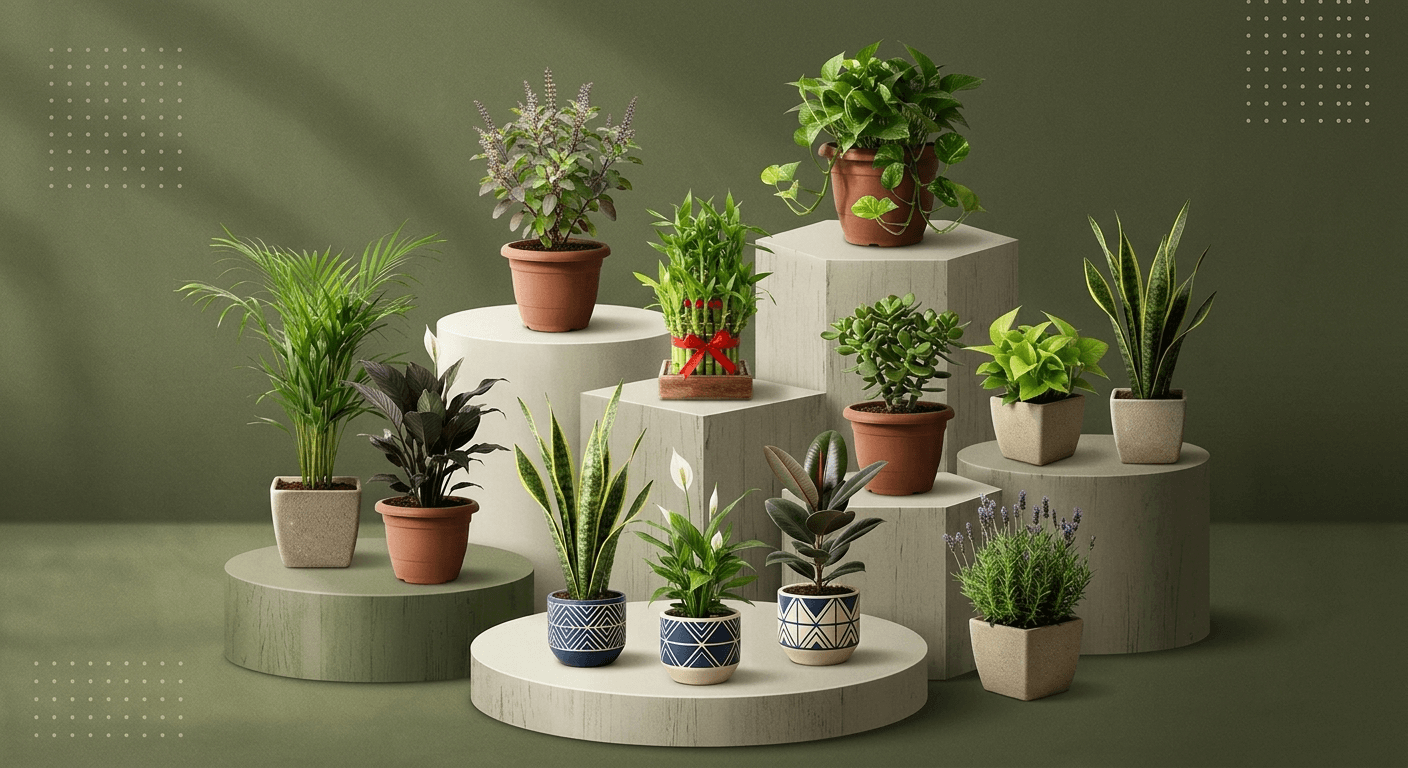
Balcony
Use 3 or 5 plants at different heights rather than filling every available corner.
This approach can help create an interior that feels modern, warm and curated rather than overcrowded.
Does the 3-5-7 Rule Apply to Furniture?
Yes, but with an important qualification.
The rule is most useful for decorative groupings and visual composition, rather than forcing every furniture layout to contain exactly three, five or seven pieces.
For example, a living room might contain:
- 1 sofa
- 2 accent chairs
- 1 coffee table
- 1 side table
That is five major furniture pieces.
But you should never purchase an unnecessary chair or table simply because you want to reach an odd number.
Furniture layout should primarily be determined by:
- Room dimensions
- Circulation
- Function
- Seating requirements
- Door and window positions
- Natural light
- Focal points
- TV viewing distance
- Storage requirements
The 3-5-7 principle can help with visual balance, but function always comes first.
3-5-7 Rule vs Symmetry in Interior Design
One of the biggest misconceptions is that odd-numbered arrangements are always better.
They are not.
Use 3-5-7 when you want:
- A relaxed look
- Natural asymmetry
- Visual movement
- A collected appearance
- Layered décor
- Contemporary styling
Use symmetry when you want:
- Formality
- Order
- Elegance
- Classical styling
- Strong architectural balance
For example, two identical lamps on either side of a bed can look more sophisticated than three lamps.
Similarly, two matching chairs opposite a fireplace can create intentional symmetry.
The best interiors combine symmetry and asymmetry strategically.
Common Mistakes When Using the 3-5-7 Rule
1. Adding Objects Just to Reach Seven
Do not add unnecessary décor simply because you have only six items.
If six objects already look balanced, stop.
2. Using Objects of the Same Height
Five objects at exactly the same height can look flat.
Instead, introduce:
- Tall
- Medium
- Low
elements.
3. Ignoring Negative Space
A beautiful arrangement still needs breathing room.
Empty space is an important part of interior design.
4. Mixing Too Many Colours
Odd-numbered groupings cannot fix a chaotic colour palette.
Choose a controlled colour scheme and repeat key colours thoughtfully.
5. Making Everything Asymmetrical
If every part of a room is asymmetrical, the overall space can lose balance.
Use asymmetry selectively.
6. Ignoring Function
A coffee table should remain usable.
A kitchen shelf should remain accessible.
A workspace should remain practical.
A decorative rule should never compromise everyday functionality.
How Interior Designers Use the 3-5-7 Rule Professionally
Professional interior design involves much more than arranging accessories.
An interior designer considers the relationship between:
- Space planning
- Furniture
- Architecture
- Lighting
- Colour
- Materials
- Texture
- Scale
- Proportion
- Storage
- Décor
- Functionality
The 3-5-7 principle is therefore best viewed as one small tool within a larger interior design system.
At Ahmedabad Interior Designer, our approach combines design planning with 3D visualization and end-to-end execution, including carpentry, electrical work, false ceiling, painting and final finishing.
This helps ensure that the finished interior is not only visually attractive but also practical for everyday living.
3-5-7 Rule Interior Design: Quick Examples
| Area | Example | Recommended Approach |
|---|---|---|
| Coffee table | Books + plant + candle | 3 |
| Small console | Vase + sculpture + bowl | 3 |
| Bookshelf | Plant + books + frame + vase + sculpture | 5 |
| Large console | Lamp + vase + books + bowl + plant + sculpture + décor | 7 |
| Gallery wall | 5 framed artworks | 5 |
| Large feature wall | 7 frames/art pieces | 7 |
| TV unit | Small groups across shelves | 3 or 5 |
| Bedroom dresser | Lamp + artwork + vase | 3 |
| Balcony | Plant groupings | 3 or 5 |
Is the 3-5-7 Rule a Strict Interior Design Rule?
No.
The 3-5-7 rule is a styling guideline, not a strict architectural standard or mandatory interior design formula.
It is useful because it gives homeowners a simple starting point when a room feels visually flat, cluttered or too symmetrical.
But experienced interior designers also consider:
- Scale
- Proportion
- Balance
- Rhythm
- Contrast
- Colour
- Texture
- Function
- Negative space
- Architectural features
The rule should help you make better decisions—not restrict your creativity.
Frequently Asked Questions About the 3-5-7 Rule
What is the 3-5-7 rule in interior design?
The 3-5-7 rule is a decorating and styling principle that recommends grouping decorative objects in odd numbers, especially three, five or seven. It is intended to create visual interest, rhythm and natural-looking asymmetry.
Why do odd numbers work in interior design?
Odd-numbered groupings can create a focal point and encourage the eye to move through an arrangement. They often feel less rigid than perfectly symmetrical pairs.
What is the difference between the rule of 3 and the 3-5-7 rule?
The rule of three focuses specifically on creating compositions using three elements. The 3-5-7 rule extends the same odd-number concept to larger arrangements using three, five or seven objects.
Can I use the 3-5-7 rule in a small living room?
Yes. In fact, three carefully selected objects can work particularly well in a small living room because they provide visual interest without creating excessive clutter.
Can I use 3-5-7 for a TV unit?
Yes. TV unit shelves are an excellent place to apply the principle. Try three or five accessories at different heights and leave sufficient negative space around them.
Does the 3-5-7 rule work for bedrooms?
Yes, particularly for dressers, shelves and decorative surfaces. However, symmetrical elements such as matching bedside lamps may be more appropriate around the bed.
Should every room have three, five or seven accessories?
No. The 3-5-7 rule is not a requirement. Use it when it improves the composition and ignore it when the space looks better with fewer objects or intentional symmetry.
Does the 3-5-7 rule make a home look expensive?
Not by itself. A premium-looking interior depends on proportion, materials, craftsmanship, lighting, colour coordination, furniture design and execution. The 3-5-7 principle can simply help improve the styling.
What is the best number for a coffee table?
Three objects are usually a practical starting point for a coffee table: for example, a tray, a small plant and a decorative object. Larger tables may accommodate five objects if there is enough space.
Can the 3-5-7 rule be used in office interior design?
Yes. It can be used for reception desks, shelves, meeting rooms, display units and artwork arrangements. However, office interiors should prioritize functionality, brand identity, ergonomics and circulation.
Final Takeaway: How to Use the 3-5-7 Rule
The easiest way to remember the 3-5-7 rule in interior design is:
3 = simple
5 = layered
7 = more elaborate
Use odd-numbered groupings to create visual interest, vary the height and scale of objects, maintain a consistent colour or material connection, and leave enough negative space around the arrangement.
Most importantly, do not follow the rule blindly.
Great interior design is about knowing when to create asymmetry and when symmetry is the better choice.
If you are planning a home interior design, 3BHK interior, villa interior, bungalow interior, office interior, modular kitchen, wardrobe, TV unit or complete turnkey interior in Ahmedabad or Gujarat, professional space planning and design can help you achieve a much more cohesive result.
Ahmedabad Interior Designer provides end-to-end interior design and execution with design planning, 3D visualization, carpentry, electrical, false ceiling, painting and final execution under one coordinated process.