The kitchen is one of the most important spaces in an Indian home. It is where food is prepared every day, making kitchen design as per Vastu an important consideration for homeowners who want their interiors to combine functionality, aesthetics and traditional Vastu principles.
According to Vastu Shastra, the kitchen is associated with Agni Tatva, or the fire element. Therefore, the direction of the kitchen, placement of the gas stove, sink, refrigerator, kitchen platform, storage cabinets, colours and ventilation are traditionally considered important when designing a Vastu-compliant kitchen.
Quick Answer: How to Design a Kitchen as per Vastu?
To design a kitchen as per Vastu, the South-East direction is traditionally considered the ideal location, because it is associated with the fire element. The North-West direction is generally considered the second option when a South-East kitchen is not possible. The cooking stove is commonly placed in the South-East portion of the kitchen, with the person cooking ideally facing East. The sink and other water-related elements should be kept away from the stove, while the kitchen should remain bright, clean, well-ventilated and clutter-free.
These principles are based on traditional Vastu beliefs rather than scientifically established effects. Practical considerations such as fire safety, ventilation, plumbing, ergonomics and efficient storage should always take priority.
What Is Kitchen Vastu?
Kitchen Vastu refers to applying traditional Vastu Shastra principles to the planning and interior design of a kitchen.
It generally considers:
- Direction of the kitchen
- Direction of the cooking stove
- Direction of the kitchen sink
- Position of the refrigerator
- Kitchen platform and countertop placement
- Cooking direction
- Kitchen entrance
- Windows and ventilation
- Storage cabinets
- Kitchen colours
- Placement of electrical appliances
- Relationship between fire and water elements
- Cleanliness and organisation
The goal is to create a kitchen that is not only aesthetically pleasing but also practical, comfortable and aligned with traditional Vastu preferences.
Why Is Vastu Important for Kitchen Design?
In Vastu Shastra, the kitchen represents the Agni element (fire). Because cooking involves heat and fire, traditional Vastu guidelines give considerable importance to where the kitchen and cooking zone are positioned.
However, good kitchen design should not be based on direction alone.
A well-designed kitchen should also provide:
- Safe cooking conditions
- Good ventilation
- Adequate natural light
- Efficient storage
- Comfortable countertop height
- Easy movement between cooking, washing and storage areas
- Proper chimney and exhaust planning
- Safe electrical connections
- Easy-to-clean surfaces
- Sufficient workspace
The best approach is therefore to combine Vastu preferences with practical kitchen planning rather than sacrificing functionality simply to follow a single directional rule.
Which Direction Is Best for a Kitchen as per Vastu?
1. South-East Kitchen – Traditionally Preferred
The South-East direction is traditionally regarded as the best direction for a kitchen because it is associated with Agni, the fire element.
If you are designing a new home and have flexibility during architectural planning, the South-East zone is commonly preferred for the kitchen.
A South-East kitchen can be planned with:
- Cooking zone toward the South-East
- Stove positioned for comfortable East-facing cooking
- Water elements kept separate from the stove
- Good ventilation
- Practical storage along suitable walls
- Adequate natural and artificial lighting
Several contemporary Vastu guides also identify South-East as the primary kitchen direction and North-West as the common alternative.
2. North-West Kitchen – Common Alternative
If a South-East kitchen is not possible because of the existing floor plan, plumbing, structural walls or apartment configuration, the North-West direction is commonly considered an alternative.
This is particularly relevant for apartments where the kitchen location is already fixed by the builder.
Instead of completely redesigning the home, you can focus on the internal arrangement:
- Position the cooking zone carefully
- Keep the stove and sink separated
- Maintain good ventilation
- Avoid unnecessary clutter
- Use efficient storage
- Keep the kitchen bright and organised
This approach is often more practical for existing flats and renovation projects.
Kitchen Directions to Avoid as per Traditional Vastu
Traditional Vastu recommendations commonly discourage placing the kitchen in the North-East, because the North-East is associated with water and spiritual qualities while the kitchen represents fire.
The exact centre of the home (Brahmasthan) is also generally not preferred for a kitchen.
However, homeowners with an existing apartment should not panic if their kitchen is already located in a different direction. Structural changes may not be practical or economical.
In such cases, focus on improving the internal kitchen layout, ventilation, lighting, stove placement, storage and separation of fire and water elements.
Where Should the Gas Stove Be Placed as per Vastu?
The gas stove or cooking hob is one of the most important elements in kitchen Vastu because it represents the fire element.
Traditionally, the stove is recommended toward the South-East portion of the kitchen.
The person cooking should ideally face East while cooking.
Kitchen stove Vastu tips:
- Place the stove in the South-East portion where practical.
- Try to arrange the cooking position so the cook faces East.
- Keep sufficient counter space around the hob.
- Avoid placing the stove immediately beside the sink.
- Do not compromise safe gas installation for Vastu.
- Provide a suitable chimney or exhaust system.
- Keep combustible materials away from the cooking area.
The east-facing cooking position is one of the most frequently repeated recommendations in current kitchen Vastu guidance.
Which Direction Should You Face While Cooking?
According to traditional Vastu, East is considered the preferred direction to face while cooking.
If the kitchen layout does not allow this, homeowners should not force an impractical arrangement. A safe, ergonomic and properly ventilated kitchen is more important than moving appliances into an unsafe position.
When designing a new kitchen, however, the cooking platform can be planned from the beginning to make East-facing cooking possible.
Where Should the Kitchen Sink Be Placed as per Vastu?
The kitchen sink represents the water element, so Vastu traditionally recommends keeping it separate from the fire element represented by the stove.
The North or North-East portion of the kitchen is commonly suggested for the sink and water-related activities.
Kitchen sink Vastu tips:
- Keep the sink away from the gas stove.
- Avoid placing the sink directly next to the hob where possible.
- Avoid placing fire and water elements directly opposite each other if the layout allows a better arrangement.
- Keep sufficient countertop space between cooking and washing areas.
- Plan plumbing before finalising cabinets and countertops.
The important practical principle is simple: keep the cooking and washing zones separate while maintaining an efficient workflow.
Stove and Sink Direction as per Vastu
One of the most searched questions about kitchen Vastu is:
“Can the stove and sink be next to each other?”
Traditional Vastu generally recommends avoiding direct proximity between the stove and sink because they represent fire and water.
From a practical kitchen-design perspective, some separation is also useful because it creates a dedicated cooking zone and washing zone.
For example:
Refrigerator → Preparation Counter → Sink → Preparation Counter → Stove
can create a comfortable workflow depending on the size and shape of the kitchen.
The exact arrangement should be customised according to the kitchen’s dimensions, plumbing and electrical points.
Kitchen Platform Direction as per Vastu
The kitchen platform should be designed around the location of the cooking zone, sink and available wall space.
For a Vastu-conscious kitchen, the cooking platform is generally planned so that the stove can occupy a suitable South-East position and the person cooking can face East.
Do not choose a countertop layout purely because it follows a directional rule.
Your platform should also provide:
- Enough preparation area
- Safe distance around the hob
- Easy access to the sink
- Convenient storage
- Proper appliance placement
- Comfortable working height
- Easy cleaning
- Adequate circulation space
A good kitchen should work effortlessly every day.
Refrigerator Direction as per Vastu
The refrigerator is another major appliance that should be considered during kitchen planning.
Traditional Vastu recommendations commonly place heavier appliances and storage toward the South, West or South-West portions of the kitchen, depending on the layout.
The refrigerator should also be positioned where:
- The door can open comfortably
- It does not block circulation
- It is away from excessive heat
- It does not interfere with the cooking zone
- There is sufficient ventilation around the appliance
Do not place a refrigerator directly beside a high-heat cooking appliance if it can be avoided.
Microwave and Electrical Appliances as per Kitchen Vastu
Microwave ovens, ovens, mixers, air fryers and other electrical appliances require practical planning.
For Vastu-oriented interiors, electrical appliances are generally associated with the fire/electrical aspect and are often planned toward suitable fire-related zones.
More importantly, make sure that:
- Electrical sockets are safely positioned.
- Appliances do not overload circuits.
- The microwave has adequate clearance.
- The oven has proper ventilation.
- Electrical points are away from water splashes.
- Wires are concealed safely.
- Appliances do not obstruct the working triangle.
Safety should always come before directional preferences.
Best Kitchen Colours as per Vastu
Colour is another popular part of Vastu kitchen design.
For a South-East kitchen, warm colours are traditionally associated with the fire element.
Popular Vastu-inspired kitchen colours include:
- Light orange
- Peach
- Warm yellow
- Terracotta
- Soft red accents
- Cream
- Beige
- Light green
- Warm earthy tones
For a North-West kitchen, lighter shades such as white, cream and soft grey are commonly recommended by Vastu practitioners.
Best approach for modern interiors
You do not need to paint the entire kitchen bright orange or red.
Instead, use Vastu-inspired colours through:
- Cabinet shutters
- Backsplash
- Decorative tiles
- Open shelves
- Small appliances
- Accessories
- Accent walls
A neutral base combined with subtle warm accents can create a modern Vastu-inspired kitchen without making the space visually overwhelming.
Which Kitchen Colours Should Be Avoided as per Vastu?
Traditional Vastu advice often recommends limiting very dark or dominant black and deep blue shades in kitchens, particularly in a South-East kitchen, because they are associated with water and are traditionally considered less compatible with the fire element.
Instead, consider:
Cream + beige + wood
or
Warm white + terracotta
or
Light neutral + muted yellow
or
Off-white + earthy green
These combinations can provide a contemporary appearance while incorporating traditional Vastu colour preferences.
Vastu Tips for Kitchen Cabinets and Storage
Storage is essential in an Indian kitchen because cookware, groceries, appliances and utensils can quickly create visual clutter.
For a Vastu-conscious kitchen, heavy storage is commonly planned toward the South and West sides, where the layout permits.
Kitchen storage tips:
- Keep heavy cabinets toward suitable heavier zones.
- Store frequently used utensils within easy reach.
- Keep overhead cabinets organised.
- Avoid unnecessary clutter on countertops.
- Keep grains and groceries in clean, closed storage.
- Do not allow broken utensils to accumulate.
- Use tall storage to maximise vertical space.
- Keep the cooking area open and easy to clean.
Good organisation is beneficial regardless of whether you follow Vastu.
Kitchen Windows and Ventilation as per Vastu
Ventilation is one of the most important aspects of kitchen design.
Cooking generates:
- Heat
- Smoke
- Steam
- Odours
- Grease particles
A properly planned kitchen should therefore have adequate ventilation through windows, exhaust systems and a chimney.
If possible, natural light and ventilation can be incorporated from suitable sides of the kitchen while ensuring privacy and building-code requirements.
A bright and well-ventilated kitchen is both a practical design principle and commonly recommended in Vastu-oriented kitchen planning.
Kitchen Door Direction and Entrance
The kitchen entrance should be planned according to the overall home layout rather than treated as an isolated Vastu rule.
Ideally, the door should:
- Allow easy movement
- Not interfere with cabinet shutters
- Not block the refrigerator
- Not create a collision point with the cook
- Maintain comfortable circulation
For compact apartments, a sliding or pocket-style solution may sometimes provide better usability than a conventional swing door, depending on the plan.
Kitchen Lighting as per Vastu
Lighting can dramatically change how a kitchen looks and feels.
For a Vastu-inspired kitchen design, aim for a bright and clean environment using:
Natural lighting
Use windows wherever the architecture allows.
Task lighting
Install focused lighting below wall cabinets to illuminate the countertop.
Ceiling lighting
Use evenly distributed ceiling lights rather than relying on a single fixture.
Decorative lighting
Pendant or profile lighting can add a premium appearance to larger kitchens.
A well-lit kitchen also makes food preparation, cleaning and storage organisation easier.
Best Kitchen Layout as per Vastu
There is no single kitchen layout that works for every home.
Depending on the room dimensions, you can choose:
L-Shaped Kitchen
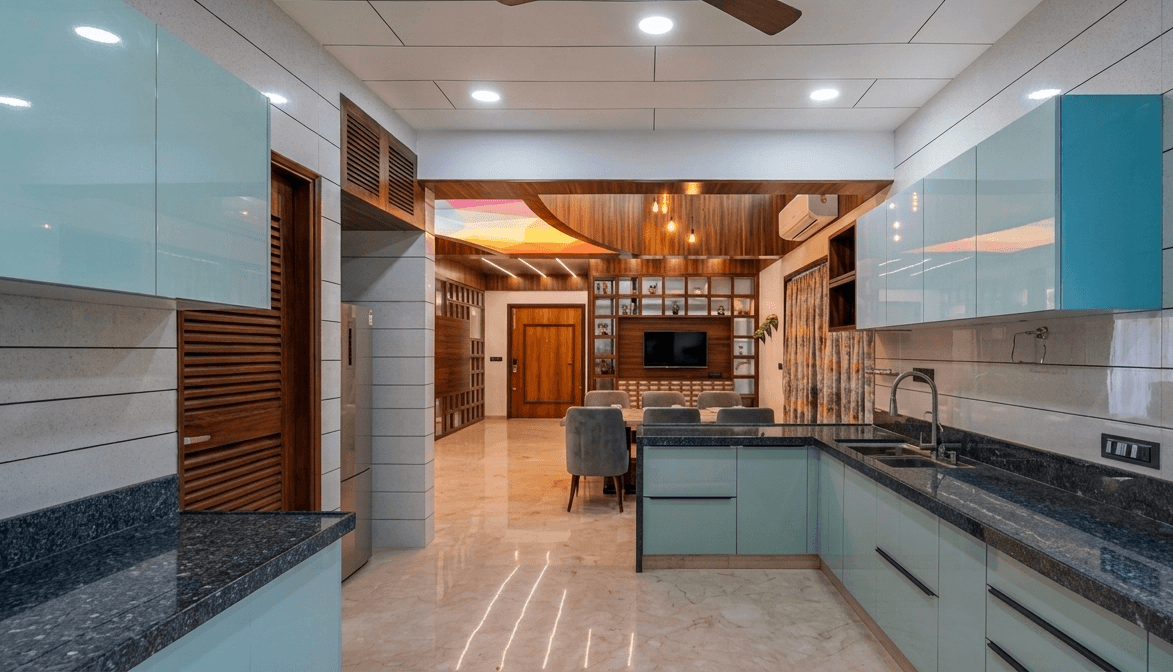
An L-shaped kitchen is excellent for many Indian apartments because it separates the cooking and washing zones while leaving the centre relatively open.
Parallel Kitchen
A parallel kitchen works well in long spaces and can provide substantial storage on two opposite sides.
U-Shaped Kitchen
A U-shaped kitchen offers generous countertop and storage space and works well in larger kitchens.
Straight Kitchen
A straight-line kitchen is ideal for compact apartments and studio-style homes.
Island Kitchen
An island kitchen works particularly well in larger open-plan homes, villas and luxury kitchens.
The best layout should balance Vastu preferences, ergonomics, storage, movement and available space.
How to Design a Small Kitchen as per Vastu?
Small kitchens require additional planning because every inch matters.
If you have a compact kitchen, focus on these principles:
- Use the South-East zone for cooking where possible.
- Plan the stove so cooking can be done facing East if practical.
- Keep the sink and stove separated.
- Use vertical storage.
- Choose light colours to visually open the room.
- Use under-cabinet lighting.
- Keep countertops clutter-free.
- Use built-in appliances where appropriate.
- Maintain proper chimney and ventilation.
- Avoid compromising safety for Vastu.
For small kitchens, functional space planning should always work together with Vastu principles.
Vastu for Modular Kitchen Design
A Vastu-compliant modular kitchen does not have to look traditional.
You can create a modern modular kitchen with:
- Acrylic or laminate cabinets
- Handleless shutters
- Quartz countertops
- Modular drawers
- Tall units
- Built-in ovens
- Chimney
- Under-cabinet lighting
- Glass shutters
- Wood finishes
- Modern backsplash tiles
The Vastu planning can happen underneath the visual design by carefully positioning the cooking, washing, storage and appliance zones.
This allows you to achieve both modern kitchen interior design and Vastu-conscious planning.
Common Kitchen Vastu Mistakes to Avoid
Here are some of the most common mistakes homeowners consider when planning a Vastu kitchen:
1. Ignoring the cooking direction
The stove should be planned carefully so the cooking position is comfortable and, where possible, allows East-facing cooking.
2. Placing the sink immediately beside the stove
Traditional Vastu recommends separating fire and water. Practical kitchen design also benefits from a dedicated preparation area between these zones.
3. Poor ventilation
A beautiful kitchen without proper ventilation can quickly become uncomfortable.
4. Excessive dark colours
Very dark colours can make a small kitchen feel enclosed and are traditionally less preferred in many Vastu recommendations.
5. Too much countertop clutter
Keep appliances and utensils organised so the kitchen remains easy to clean.
6. Ignoring electrical planning
Sockets should be planned before cabinetry and backsplash installation.
7. Sacrificing ergonomics for Vastu
A kitchen should never become unsafe or difficult to use simply to satisfy a directional rule.
8. Forgetting the work triangle
The refrigerator, sink and cooking zone should have a logical relationship to reduce unnecessary movement.
What If Your Kitchen Is Not in the South-East?
This is one of the most important questions for apartment owners.
Many homeowners purchase a completed flat where the kitchen location cannot be changed.
If your kitchen is not in the South-East, there is no need to undertake major structural changes automatically.
Instead, you can review:
- Stove position
- Cooking direction
- Sink position
- Separation between fire and water
- Ventilation
- Lighting
- Storage
- Colour palette
- Appliance placement
- Cleanliness and organisation
Some Vastu practitioners also recommend specific remedies for kitchens in less-preferred directions, but these recommendations vary considerably.
For an existing home, practical modifications should be considered before expensive structural changes.
Vastu Remedies for an Existing Kitchen
If changing the kitchen’s location is impossible, homeowners sometimes explore traditional Vastu remedies.
Depending on the specific layout, commonly discussed approaches include:
- Repositioning the cooking stove where practical
- Creating greater separation between stove and sink
- Introducing suitable colours
- Improving natural light
- Keeping the kitchen clean and clutter-free
- Improving ventilation
- Reorganising storage
- Using traditional Vastu objects or remedies recommended by a qualified practitioner
There is no universal remedy that works for every floor plan. The appropriate approach depends on the home’s orientation, kitchen location, room dimensions and existing services.
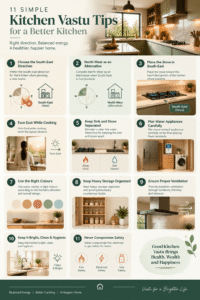
11 Simple Kitchen Vastu Tips for a Better Kitchen
If you want a quick checklist, use these 11 kitchen Vastu tips:
- Prefer the South-East direction for the kitchen when planning a new home.
- Consider North-West as an alternative when South-East is not practical.
- Place the stove toward the South-East portion of the kitchen where possible.
- Face East while cooking when the layout allows it.
- Keep the sink and stove separated to maintain a clear fire-water distinction.
- Plan water-related appliances carefully rather than placing them randomly.
- Use warm, earthy or light colours according to the kitchen’s direction and overall design.
- Keep heavy storage organised and avoid unnecessary countertop clutter.
- Provide excellent ventilation through windows, chimney and exhaust.
- Keep the kitchen bright, clean and hygienic.
- Never compromise fire, electrical or gas safety for Vastu.
Vastu Kitchen Design: Traditional Principles + Modern Interior Design
The best kitchen design does not need to look old-fashioned.
A modern Vastu kitchen can combine traditional principles with contemporary interior design through:
Vastu planning + modular storage + premium materials + efficient lighting + ergonomic layout + modern appliances.
For example, a South-East kitchen can feature:
- Warm neutral cabinetry
- Wood-finish tall units
- Quartz countertop
- Terracotta backsplash accents
- Built-in appliances
- Under-cabinet lighting
- Hidden storage
- Modern chimney
- Organised pantry
- Easy-clean surfaces
This creates a kitchen that feels modern while still respecting the homeowner’s Vastu preferences.
Frequently Asked Questions About Kitchen Vastu
Which direction is best for a kitchen as per Vastu?
The South-East direction is traditionally considered the preferred direction for a kitchen because it is associated with the fire element, Agni. North-West is commonly considered an alternative when South-East is not possible.
Which direction should the gas stove face as per Vastu?
The traditional recommendation is to position the stove so that the person cooking faces East. The stove itself is commonly planned toward the South-East portion of the kitchen.
Where should the kitchen sink be according to Vastu?
The sink is commonly recommended toward the North or North-East side of the kitchen, while keeping it separated from the stove.
Can the kitchen be in the North-West as per Vastu?
Yes. While South-East is traditionally preferred, North-West is commonly considered a secondary kitchen direction, particularly when the South-East location is not possible.
Which colour is best for a kitchen as per Vastu?
Commonly recommended Vastu kitchen colours include warm yellow, orange, peach, terracotta, cream and earthy shades. For some North-West kitchens, white and cream are also commonly suggested.
Is a North-East kitchen bad as per Vastu?
Traditional Vastu generally considers the North-East a less suitable location for a kitchen because the kitchen represents fire while the North-East is traditionally associated with water and spiritual qualities. However, for an existing apartment, practical internal planning may be more realistic than structural relocation.
Can I have a modular kitchen according to Vastu?
Yes. A modular kitchen can absolutely incorporate Vastu principles. The key areas to consider are the kitchen direction, stove placement, cooking direction, sink location, storage, colours and separation of fire and water.
Is Vastu scientifically proven?
Vastu Shastra is a traditional architectural and spatial-planning belief system. Claims that particular directions directly cause health, wealth or other outcomes are not established scientific facts. Vastu can be considered alongside practical factors such as ergonomics, ventilation, lighting, hygiene and safety.
Final Checklist: Is Your Kitchen Vastu-Friendly?
Before finalising your kitchen interior design, check:
☐ Is the kitchen preferably located in the South-East?
☐ If not, can the North-West work better within the existing floor plan?
☐ Is the stove positioned appropriately?
☐ Can you comfortably face East while cooking?
☐ Is the sink separated from the stove?
☐ Is the kitchen properly ventilated?
☐ Is there enough natural and artificial lighting?
☐ Are the countertops clutter-free?
☐ Is there sufficient storage?
☐ Are electrical points safely planned?
☐ Is the refrigerator positioned without obstructing movement?
☐ Are the colours suitable for your preferred Vastu approach?
☐ Does the kitchen remain comfortable and practical for everyday use?
Design a Vastu-Compliant Kitchen That Actually Works
A well-designed kitchen should be more than a collection of Vastu rules. It should be a space where cooking is comfortable, storage is organised, movement is effortless and the design feels right for your home.
If you are building a new home or renovating an existing kitchen, Vastu can be incorporated during the planning stage by considering the kitchen direction, stove placement, sink position, storage, colours, lighting and ventilation together.
For homeowners in Ahmedabad and Gujarat, a customised kitchen plan can also take into account the apartment layout, society restrictions, plumbing points, electrical requirements, available space and your preferred interior style.
Ahmedabad Interior Designer provides end-to-end home interior design and execution, including modular kitchens, custom storage, carpentry, electrical work, false ceiling, painting, 3D visualisation and complete turnkey interiors.