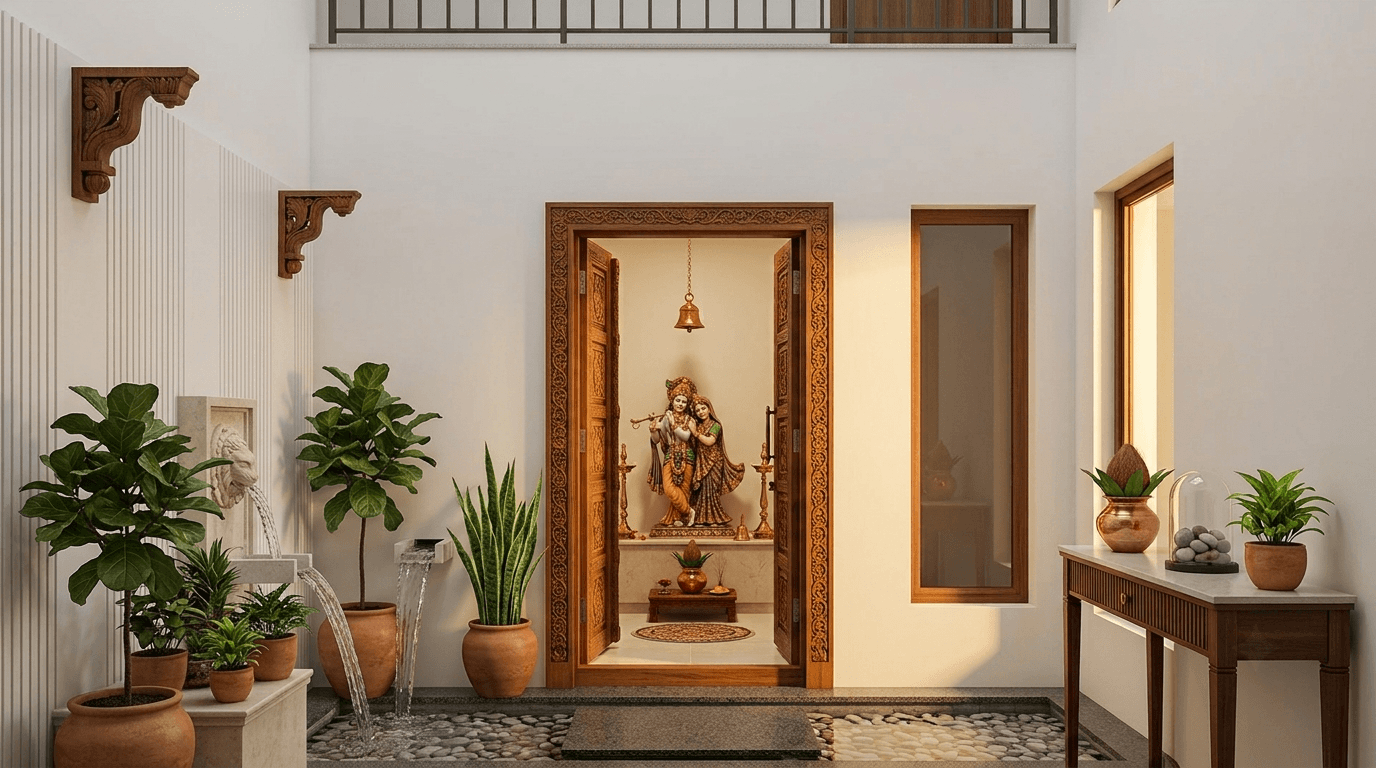
A pooja room is one of the most spiritually important spaces in an Indian home. According to traditional Vastu Shastra, its direction, location, entrance, deity placement, lighting, colours, and cleanliness can be planned to create a calm and positive environment.
If you are wondering what are the Vastu rules for a pooja room, the most commonly recommended approach is to place the pooja room in the North-East (Ishan) direction of the home. If the North-East is not practical, the East or North can be considered depending on the home’s layout. The idols should be positioned thoughtfully, the room should remain clean and well ventilated, and the pooja space should preferably be away from toilets and clutter.
Quick Answer: What Are the Main Vastu Rules for a Pooja Room?
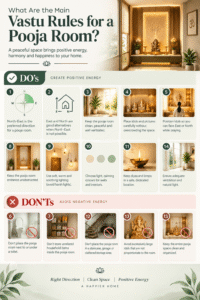
Here are the most important pooja room Vastu rules at a glance:
- North-East is traditionally considered the preferred direction for a pooja room.
- East and North can be considered as alternative locations when North-East is not possible.
- Keep the pooja room clean, peaceful and well ventilated.
- Place idols and pictures of deities carefully rather than overcrowding the space.
- When practical, position the idols so that the person praying can face East or North.
- Avoid placing the pooja room directly next to or under a toilet.
- Avoid storing unrelated household items inside the pooja room.
- Keep the main entrance of the pooja room unobstructed.
- Use soft, warm and soothing lighting rather than harsh illumination.
- Choose light, calming colours for the walls and interiors.
- Keep diyas and lamps in a safe, dedicated location.
- Avoid placing the pooja room in a staircase, garage or cluttered storage area.
- Maintain adequate ventilation and natural light where possible.
- Avoid excessively large idols that are disproportionate to the room.
- Keep the entire pooja space clean and organized.
Vastu tip: For a new home, the North-East is traditionally preferred for a pooja room. However, the best location also depends on the actual floor plan, entrances, toilets, bedrooms, kitchen and structural constraints.
1. Which Direction Is Best for a Pooja Room as per Vastu?
The North-East direction, traditionally known as Ishan Kona, is widely considered the preferred location for a pooja room according to Vastu Shastra.
The North-East is associated with openness, light and spiritual practices in traditional Vastu principles. If you are designing a new home and have flexibility in planning, the North-East can therefore be considered for the pooja room.
Other directions commonly considered
If a North-East pooja room is not possible, East and North are often considered alternatives.
The final decision should take into account the complete floor plan rather than choosing a direction in isolation.
2. Where Should a Pooja Room Be Located in the House?
Ideally, the pooja room should occupy a quiet, clean and peaceful area of the home.
For larger homes, villas and bungalows, a dedicated pooja room can be designed separately. In apartments, however, space can be limited, so a compact pooja unit or prayer niche can be incorporated into the living or dining area.
When selecting the location, consider:
- Direction of the room
- Natural light
- Ventilation
- Privacy
- Distance from toilets
- Distance from clutter and storage
- Ease of daily access
- Placement of doors and windows
- Overall room layout
This makes pooja room Vastu practical rather than treating direction as the only consideration.
3. Which Direction Should You Face While Praying?
A commonly followed Vastu principle is to face East while praying, particularly when the layout allows it.
North is also considered a favourable direction in many traditional Vastu practices.
The important point is to plan the deity placement and worshipper’s position together. Simply placing the mandir in a particular direction without considering where you will sit or stand may not produce a practical layout.
4. How Should Idols Be Placed in a Pooja Room?
Idol placement is an important part of Vastu for pooja room.
The idols should be arranged neatly with sufficient space around them. Avoid turning the pooja room into a crowded display area containing too many statues and photographs.
A practical pooja unit should allow enough room for:
- Daily prayer
- Diya placement
- Incense
- Pooja essentials
- Cleaning
- Comfortable movement
Important idol-placement considerations
- Keep idols clean and properly maintained.
- Avoid placing damaged or broken idols in the regular pooja setup.
- Do not overcrowd the mandir.
- Keep adequate space between idols.
- Avoid placing idols directly on the floor.
- Use a raised platform, shelf or properly designed mandir unit.
5. Should the Pooja Room Have a Door?
A dedicated pooja room can have a door, particularly when privacy and cleanliness are important.
For compact apartments, a mandir with doors, jaali panels or a partition can create a defined prayer space without requiring an entire room.
The door should open comfortably and should not obstruct the prayer area.
For a modern home, designs such as:
- Wooden pooja doors
- Fluted-glass partitions
- CNC jaali panels
- Sliding partitions
- Backlit marble mandirs
- Minimalist wooden temples
can create a dedicated spiritual zone while maintaining the overall interior design.
6. Where Should the Diya Be Placed?
A diya is an integral part of many Indian prayer rituals.
Rather than placing lamps wherever there is available space, create a dedicated and safe diya area within the pooja unit.
Keep the diya:
- On a stable surface
- Away from curtains and combustible materials
- Away from electrical wiring
- In a location that is easy to clean
- Where it cannot be accidentally knocked over
Traditional Vastu guidance should always be balanced with basic fire safety.
7. What Colours Are Best for a Pooja Room?
For a peaceful pooja room, light and soothing colours are commonly preferred.
Suitable choices can include:
- White
- Off-white
- Cream
- Beige
- Light yellow
- Soft peach
- Light wood tones
You can also introduce natural materials such as wood and stone to create a warm, grounded appearance.
Avoid making the space excessively dark if the goal is to create a bright and tranquil prayer area.
8. Is Natural Light Important in a Pooja Room?
Yes. A pooja room should ideally have good natural light and ventilation.
If the architecture allows it, consider:
- A window
- Ventilation opening
- Skylight
- Jaali partition
- Glass panel
- Open prayer niche
Natural light can make a small pooja room feel more spacious and peaceful.
However, the location of windows and openings should be planned according to the overall floor plan rather than adding them solely for Vastu considerations.
9. Can a Pooja Room Be in the Living Room?
Yes. A separate pooja room is not always necessary.
This is particularly useful in:
- Apartments
- 2BHK and 3BHK homes
- Compact urban houses
- Rental homes
- Homes with limited floor area
You can create a dedicated pooja corner in the living room using a wooden mandir, wall-mounted temple, partition or custom cabinet.
For a Vastu-conscious layout, consider the North-East, East or North portion of the available space where practical.
10. Can the Pooja Room Be in the Bedroom?
A dedicated pooja room is generally preferable to placing the mandir inside a bedroom.
However, modern homes sometimes have significant space constraints. If a bedroom is the only practical option, the complete room layout should be assessed before deciding where to place the prayer unit.
If a pooja unit must be incorporated into a bedroom, keeping it clean, private and visually separated can make the arrangement more appropriate from a practical standpoint.
11. Can the Pooja Room Be Near a Toilet?
Traditionally, placing a pooja room directly next to, above or below a toilet is generally avoided in Vastu planning.
When designing a new home, try to position the prayer area away from toilets wherever the floor plan allows.
However, existing apartments often have fixed plumbing shafts and structural limitations. In such cases, redesigning an entire home solely around this one consideration may not be practical.
A professional floor-plan review can help identify workable alternatives.
12. Should a Pooja Room Be Under a Staircase?
A pooja room is traditionally not preferred under a staircase.
The space below stairs is often better used for storage or other practical functions, depending on the home’s design.
If you have a very small apartment and are considering a compact mandir under stairs, assess the space carefully for:
- Head clearance
- Ventilation
- Moisture
- Cleanliness
- Accessibility
- Overall comfort
A dedicated, open and peaceful prayer space is generally more practical.
13. What Should Not Be Kept in a Pooja Room?
One of the simplest Vastu tips for pooja room is to avoid turning the space into a storage area.
Avoid keeping:
- Unused household items
- Shoes
- Cleaning supplies
- Random boxes
- Broken decorative objects
- Unrelated paperwork
- Excessive electrical equipment
- Cluttered containers
The pooja room should remain organized and easy to clean.
14. How High Should the Pooja Unit Be?
There is no universal height that works for every home.
The mandir should be designed so that the idols are positioned comfortably for daily prayer and maintenance.
For a wall-mounted pooja unit, consider:
- Adult eye level
- Seating position
- Idol size
- Shelf depth
- Diya placement
- Cleaning access
- Ceiling height
For a floor-level traditional mandir, the platform can be designed around the room’s proportions.
Good interior design matters here: a mandir should look proportionate to the room rather than being oversized simply because the space is available.
15. Can You Have a Pooja Room in an Apartment?
Absolutely.
A dedicated pooja room is ideal when space permits, but Vastu for pooja room in apartments can be incorporated through thoughtful space planning.
Popular apartment solutions include:
Wall-mounted Mandir
Ideal for compact homes where floor space is limited.
Pooja Cabinet
A closed cabinet can keep the prayer area protected and visually organized.
Pooja Niche
A recessed wall niche can create a dedicated spiritual area without taking up much space.
Partitioned Pooja Area
A wooden, glass or jaali partition can visually separate the mandir from the living room.
Compact Corner Temple
A small custom temple can be designed into an otherwise unused corner.
Pooja Room Vastu for Different Types of Homes
Pooja Room Vastu for 2BHK and 3BHK Flats
In apartments, space planning is often the biggest challenge.
Consider a compact mandir in the:
- North-East portion
- East portion
- North portion
where practical.
A wall-mounted temple or custom pooja cabinet can work particularly well in a 3BHK apartment.
Pooja Room Vastu for Villas and Bungalows
Larger homes provide more flexibility.
You can create:
- Dedicated pooja room
- Traditional temple room
- Marble mandir
- Wooden temple
- Double-height prayer space
- Pooja room with jaali partition
- Pooja room with natural skylight
The room can be designed as an architectural feature rather than simply adding a small cabinet.
Modern Pooja Room Design Ideas as per Vastu
Following Vastu does not mean your pooja room needs to look traditional.
A modern Vastu-compliant pooja room design can combine traditional principles with contemporary interiors.
Some popular ideas include:
1. Minimalist Wooden Mandir
Use natural wood, simple detailing and warm lighting.
2. Marble Pooja Unit
White or light-coloured marble can create an elegant and timeless appearance.
3. Backlit Jaali
A CNC-cut or carved jaali behind the idols can create a beautiful focal point.
4. Fluted Glass Partition
This works well when the pooja area is part of the living room.
5. Compact Pooja Niche
Perfect for apartments where every square foot matters.
6. Traditional + Modern Fusion
Combine wooden detailing, brass elements, subtle lighting and contemporary cabinetry.
11 Common Pooja Room Vastu Mistakes to Avoid
Avoid these common mistakes when planning a mandir:
- Choosing the location without considering the complete floor plan.
- Making the pooja room excessively dark.
- Allowing the space to become cluttered.
- Keeping unrelated storage inside the mandir.
- Overcrowding the shelves with too many idols.
- Placing idols directly on the floor.
- Ignoring ventilation.
- Keeping diyas near combustible materials.
- Placing the prayer area in an inconvenient location.
- Designing an oversized mandir for a small room.
- Treating Vastu as the only factor while ignoring practical design and safety.
Pooja Room Vastu Checklist
Before finalizing your pooja room, use this quick checklist:
| Pooja Room Element | Vastu-Friendly Planning |
|---|---|
| Preferred direction | North-East |
| Alternative directions | East / North |
| Prayer orientation | East or North where practical |
| Lighting | Bright, warm and peaceful |
| Ventilation | Good natural ventilation |
| Colours | Light, soothing shades |
| Idols | Clean, organized and proportionate |
| Storage | Minimal and dedicated |
| Diya | Stable and fire-safe location |
| Toilets | Avoid direct proximity where possible |
| Staircase | Traditionally avoided |
| Clutter | Avoid |
| Entrance | Clear and unobstructed |
| Design | Proportionate to room size |
What Is the Best Direction for a Pooja Room?
The North-East direction is traditionally considered the preferred direction for a pooja room according to Vastu Shastra. East and North are commonly considered alternatives when North-East is not practical.
However, the direction alone does not determine whether a pooja room is suitable. The placement of doors, toilets, bedrooms, kitchen, windows, furniture and structural elements should also be considered when planning the space.
Frequently Asked Questions About Pooja Room Vastu
Which direction is best for a pooja room?
The North-East direction is traditionally considered the preferred location for a pooja room. East and North may also be considered depending on the home’s layout.
Which direction should God face in a pooja room?
Idol placement should be planned carefully so that worshippers can comfortably face an appropriate direction, commonly East or North, during prayer. The exact arrangement depends on the deity, room dimensions and overall layout.
Can a pooja room be in the living room?
Yes. A compact pooja unit can be incorporated into a living room, particularly in apartments. A dedicated niche, cabinet or partition can create a defined prayer space.
Can a pooja room be in the bedroom?
A separate pooja room is generally preferable. If space limitations make this unavoidable, the mandir should be kept clean, private and visually separated from the sleeping area.
Can a pooja room be near a bathroom?
Traditional Vastu planning generally avoids placing the pooja room directly next to, above or below a toilet. When designing a new home, the floor plan can be arranged to create separation.
Which colour is best for a pooja room?
Light and soothing colours such as white, cream, beige and light yellow are commonly chosen for pooja rooms.
Can a pooja room be under a staircase?
It is traditionally avoided. If there is no alternative, the space should at least be assessed for ventilation, cleanliness, accessibility and practical comfort.
Is North-East the only direction for a pooja room?
No. North-East is traditionally preferred, but East and North are also commonly considered depending on the floor plan and practical constraints.
Can I have a pooja room in a small flat?
Yes. A wall-mounted mandir, pooja cabinet, niche or partitioned prayer corner can work well in a compact apartment.
How can I make a modern pooja room according to Vastu?
Start with the available floor plan and consider the North-East, East or North portion where practical. Then combine appropriate idol placement, lighting, ventilation, storage and calming materials with a modern interior design.
Final Thoughts: How to Plan a Vastu-Friendly Pooja Room
A well-designed pooja room should be peaceful, clean, functional and proportionate to the home. Traditional Vastu principles commonly favour the North-East, with East and North also considered in many layouts. But a good pooja room design should also account for natural light, ventilation, safety, accessibility and the actual structure of the house.
Whether you are designing a 3BHK apartment, luxury villa, bungalow or compact urban home, Vastu principles can be incorporated without compromising modern aesthetics.
The best approach is to begin with the complete floor plan, identify the most suitable location, and then design the mandir around the family’s daily prayer habits and the home’s architecture.
For a new home or renovation, an experienced interior designer can help integrate Vastu, space planning, custom pooja room design, lighting, storage and overall interior aesthetics into one practical solution.